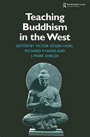
- Author
- Hori, Victor Sogen, Richard P. Hayes and J. Mark Shields, eds.
- Publisher
- RoutledgeCurzon, Taylor & Francis Group, New York, NY
- ISBN
- 700715576
- Table of Contents
-
Acknowledgments
Introduction (Victor Sogen Hori)
List of Contributors
Part I: Teaching Buddhism: Past and Present
ch. 1 Teaching Buddhism in the Postmodern University: Understanding, Critique, Evaluation (Frank E. Reynolds)
ch. 2 Buddhist Studies in the Academy: History and Analysis (Charles S. Prebish)
Part II: What is "Buddhism"
ch. 3 Representations of Buddhism in Undergraduate Teaching: The Centrality of Ritual and Story Narratives (Todd T. Lewis)
ch. 4 Moving Beyond the "ism": A Critique of the Objective Approach to teaching Buddhism (O'Hyun Park)
Part III: Cultural Divides
ch. 5 Black Ships, Blavatsky, and the Pizza Effect: Critical Self-Consciousnes as a Thematic Foundation for Courses in Buddhist Studies (Stephen Jenkins)
ch. 6 An End-run round Entities: Using Scientific Analogies to Teach Basic Buddhist Concepts (William S. Waldron)
Part IV Skillful Means
ch. 7 Engaging Buddhism: Creative Tasks and Student Participation (Joanne Wotypka)
ch. 8 The Peripaetetic Class: Buddhist Traditions and Myths of Pedagogy (E. H. Rick Jarow)
Part V: Buddha Body, Buddha Mind
ch. 9 Buddhism and the Teaching of Jūdō (David Waterhouse)
ch. 10 Introducing Buddhism in a Course of Postmodernism (Susan Mattis)
ch. 11 Liberal Education and the Teaching of Buddhism (Victor Sōgen Hori)
Part VI: The Wheel Comes to the Web
ch. 12 Teaching Buddhism by Distance Education: Traditional and Web-based Approaches (Mavis L. Fenn)
ch. 13 Academic Buddhology and the Cyber-Sangha: Researching and Teaching Buddhism on the Web (Brett Greider)
At a time when the popularity of Buddhism is at a peak in the west, both inside and outside the university setting, scholars and students alike are searching for guidance: How should Buddhism, a religion which is ultimately 'foreign' to western experience, be taught? How should one teach central Buddhist doctrines and ideas? Should one teach Buddhist practise; if so how? Until now, those interested in these and other related matters have been left with little guidance. Despite the wealth of scholarly publications on Buddhist traditions and the plethora of books about meditation and enlightenment, a serious lacuna exists in the sphere of teaching Buddhism.
This book fills this lacuna, by providing a series of thematically arranged articles written by contemporary scholars of Buddhism throughout North America. Some of the major themes covered are the history of teaching Buddhism in Europe and North America (Reynolds, Prebish), the problem of representations of Buddhism in undergraduate teaching (Lewis), the problem of crossing cultural and historical divides (Jenkins), the place of the body and mind in the Buddhist classroom (Waterhouse), alternative pedagogical methods in teaching Buddhism (Wotypka, Jarow, Hori, Grimes) and the use of the Internet as a resource, and metaphor for teaching Buddhism (Fenn, Grieder). (From the Publisher)
This book fills this lacuna, by providing a series of thematically arranged articles written by contemporary scholars of Buddhism throughout North America. Some of the major themes covered are the history of teaching Buddhism in Europe and North America (Reynolds, Prebish), the problem of representations of Buddhism in undergraduate teaching (Lewis), the problem of crossing cultural and historical divides (Jenkins), the place of the body and mind in the Buddhist classroom (Waterhouse), alternative pedagogical methods in teaching Buddhism (Wotypka, Jarow, Hori, Grimes) and the use of the Internet as a resource, and metaphor for teaching Buddhism (Fenn, Grieder). (From the Publisher)