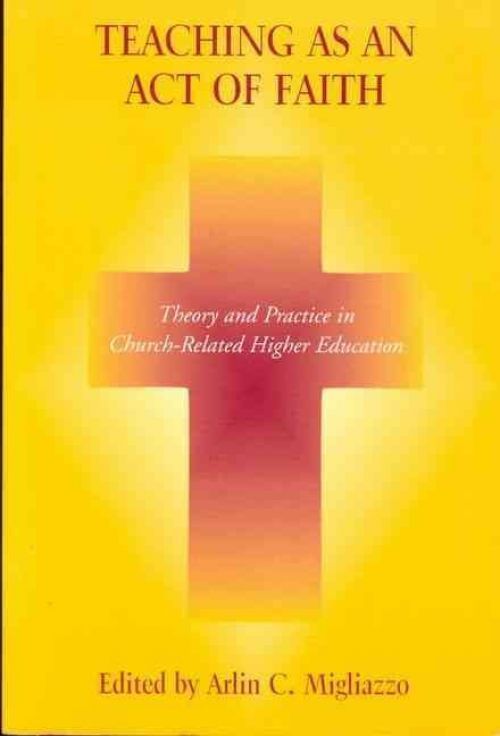
- Author
- Migliazzo, Arlin C.
- Publisher
- Fordham University Press, New York, NY
- ISBN
- 823222209
- Table of Contents
-
Foreword
Acknowledgments
Introduction: An Odyssey of the Mind and Spirit
Pt. 1 The Social Sciences
ch. 1 Teaching Economics While Keeping the Faith
ch. 2 Scuttling the Schizophrenic Student Mind: On Teaching the Unity of Faith and Learning in Psychology
ch. 3 At the Lectern Between Jerusalem and Sarajevo: A Christian Approach to Teaching Political Science
ch. 4 Sociology and Faith: Inviting Students into the Conversation
Pt. 2 The Natural Sciences
ch. 5 Developing a Christian Perspective on the Nature of Mathematics
ch. 6 Christian Theism: Alive and Well in the Physics and Astronomy Classroom
ch. 7 A Careful Convergence: Integrating Biology and Faith in the Church-Related College
Pt. 3 The Fine Arts
ch. 8 "I Love to Tell the Story:" Teaching Theatre at a Church-Related College
ch. 9 Toward a Christian Pedagogy of Art
ch. 10 Music Pedagogy and the Christian Faith: A Twenty-Year Journey of Discovery
Pt. 4 The Humanities
ch. 11 An Ignatian Approach to Teaching Philosophy
ch. 12 Teaching Literature as Mediation: A Christian Practice
ch. 13 Faith, Learning, and the Teaching of History
ch. 14 Christian Faith and the Teaching of Speech Communication
Conclusion: A Prudent Synergy: Pedagogy for Mind and Spirit
App Christianity and Higher Education: A Selected Bibliography
App Ecumenical Christian Professional Associations
Notes on Contributors
Index
Interest in church-related higher education has increased greatly in recent years. Teaching as an Act of Faith is a practical guidebook on strategies to incarnate mission and epitomize theological and theoretical reflection in the classroom. In original essays, distinguished practitioners from fourteen liberal arts disciplines and Roman Catholic, Wesleyan, Anabaptist, Lutheran, and Reformed traditions demonstrate how they have been able link religious values more directly to their teaching. (From the Publisher)