Home » Resources » Scholarship on Teaching » Teaching and Digital Technologies: Big Issues and Critical Questions
Scholarship
March 29, 2017
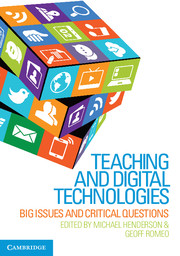
Teaching and Digital Technologies: Big Issues and Critical Questions
- Author
- Henderson, Michael; and Romeo, Geoff
- Publisher
- Cambridge University Press, New York, NY
- ISBN
- 9781107451971
- Table of Contents
-
Forward
Preface for Teacher Educators and Professional Learning Leaders
Contributors
Acknowledgements
ch. 1 Why focus on big issues and critical questions? (Michael Henderson an Geoff Romeo)
Section 1 - Being Critical of Our Assumptions: Learners, Learning and Digital Technologies
ch. 2 Digital Natives and Other Myths (Nichola F. Johnson)
ch. 3 Learning, Teaching, Technology: Confusing, Complicated and Contested! (Geoff Romeo)
ch. 4 Balancing Risks and Growth in a Digital World (Jennifer Masters)
ch. 5 Digital Technologies and Equity: Gender, Digital Divide and Rurality (Neil Anderson)
ch. 6 Using Digital Technologies with Aboriginal and Torres Strait Islander Students (Glenn Auld and Lena Djabibba)
Section 2 - Technology Affordances: What’s So Special About Digital Technologies?
ch. 7 Computational Thinking: Philosophy and Practice (Andrew Fluck and Matt Bower)
ch. 8 Creativity, Visualisation, Collaboration and Communication (Glenn Finger)
ch. 9 Breaking Boundaries (Chris Campbell)
ch. 10 Using Social Media: Assumptions, Challenges and Risks (Michael Henderson)
ch. 11 Gamification and Digital Games-Based Learning in the Classroom (Sue Gregory, Torsten Reiners, Lincoln C. Wood, Hanna Teräs, Marko Teräs and Michael Henderson)
ch. 12 Mobile Learning: What Is It and What Are It’s Possibilities? (Mark Pegrum)
Section 3 - Policy: Curriculum, Values and Agendas
ch. 13 Considering the History of Digital Technologies in Education (Sarah K. Howard and Adrian Mozejko)
ch. 14 Digital Technologies in the Curriculum: National and International (Jason Zagami)
ch. 15 Never Believe The Hype: Questioning Digital ‘Disruption’ and Other Big Ideas (Neil Selwyn)
Section 4 - Student Learning
ch. 16 When Does Technology Improve Learning? (C. Paul Newhouse)
ch. 17 Making Learning Visible Through Digital Forms of Assessment (C. Paul Newhouse)
ch. 18 Learning With Digital Technologies (Peter Albion)
ch. 19 Project, Problem, and Inquiry Based Learning (Peter Albion)
ch. 20 Numeracy and Technology (Donna Gronn and Ann Downton)
ch. 21 Digital Literacy in Theory, Policy and Practice: Old Concerns, New Opportunities (Scott Bulfin and Kellie McGraw)
ch. 22 Digital Technologies in Early Childhood Education (Susan Edwards)
Section 5 - Professional Learning
ch. 23 National and International Frameworks for Teacher Competency (Margaret Lloyd)
ch. 24 Teachers: Technology, Change and Resistance (Sarah K. Howard and Adrian Mozejko)
ch. 25 Digital Technology Integration (Michael Phillips)
ch. 26 Ongoing Professional Learning (Kathryn Holmes and Nicole Mocker)
Index
Teaching and Digital Technologies: Big Issues and Critical Questions helps both pre-service and in-service teachers to critically question and evaluate the reasons for using digital technology in the classroom. Unlike other resources that show how to use specific technologies – and quickly become outdated, this text empowers the reader to understand why they should, or should not, use digital technologies, when it is appropriate (or not), and the implications arising from these decisions. The text directly engages with policy, the Australian Curriculum, pedagogy, learning and wider issues of equity, access, generational stereotypes and professional learning. The contributors to the book are notable figures from across a broad range of Australian universities, giving the text a unique relevance to Australian education while retaining its universal appeal. Teaching and Digital Technologies is an essential contemporary resource for early childhood, primary and secondary pre-service and in-service teachers in both local and international education environments.
Empowers pre-service and in-service teachers to understand why they should or should not use digital technologies
Notable team of contributors from across a broad range of Australian universities
Companion website is kept up-to-date with any major technological changes as well as emerging ideas, debates, policy and other relevant information
(From the Publisher)
Empowers pre-service and in-service teachers to understand why they should or should not use digital technologies
Notable team of contributors from across a broad range of Australian universities
Companion website is kept up-to-date with any major technological changes as well as emerging ideas, debates, policy and other relevant information
(From the Publisher)