Home » Resources » Scholarship on Teaching » Teaching About Asian Pacific Americans: Effective Activities, Strategies, and Assignments for Classrooms and Communities
Scholarship
March 29, 2017
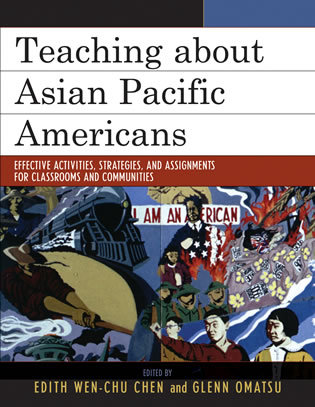
Teaching About Asian Pacific Americans: Effective Activities, Strategies, and Assignments for Classrooms and Communities
- Author
- Chen, Edith Wen-Chu, and Omatsu, Glenn
- Publisher
- Rowman & Littlefield, Publishers, Lanham, MD
- ISBN
- 9780742553385
- Table of Contents
-
Acknowledgments
Introduction
Part I: Definitions, Concepts, and Issues
ch. 1 Vietnamese Boat People: Separation and Loss
ch. 2 Feast of Resistance: Asian American History Through Food
ch. 3 "Pin@y Time": Mapping the Filipino American Experience
ch. 4 Deconstructing the Model Minority Image: Asian Pacific Americans, Race, Class, Gender, and Work
ch. 5 Building Allies: Linking Race, Class, Gender, and Sexuality in Asian American Studies
ch. 6 Globalization and Transnationalism Role-Playing Activity: Korean Immigrants and the Garment Industry
ch. 7 Expressive Therapies for Asian American Clients: The Value of Nonverbal Sand Tray Therapy
ch. 8 Are High Achieving Asians Individualists?
ch. 9 Representations of Asian Americans in Advertising Constructing Images of Asian Americans
ch. 10 Ripping Up Cultures: Helping Students Reconnect with Their Cultural Values
Part II: War, Colonialism, and Imperialism
ch. 11 Paradise and the Politics of Tourist Hawai'i
ch. 12 Racializing the "Enemy": Japanese Americans after 12/7/41 and American Muslims and Arabs after 9/11/01
ch. 13 Teaching about Hindus and Muslims in the USA: "Any all they will call you will be deportee"
ch. 14 On the Curses and Blessings of War: Discussions for a Filipino American Experience Class
ch. 15 Addressing Redress: Japanese American's Reparations for Their Incarceration during World War II
Part III: Community Building, Learning, and Organizing
ch. 16 Making Student Leadership Development an Integral Part of Our Classrooms
ch. 17 Beyond the Egg Rolls, Fortune Cookies, and Paper Fans: Seeing the Residential Side of Chinatown
ch. 18 Mobilizing Students to Respond to Community Needs: Organizing a Class around a Community Project
ch. 19 Bridging Generations: Bringing the Experiences of Illness, Health, and Aging into the Classroom
ch. 20 Oral History and Multiculturalism
ch. 21 Bridging Asian American and African American Communities
Part IV: Critical Thinking Teaching Strategies
ch. 22 Understanding Privilege in American Society
ch. 23 An Exploration of Meaning: Critically Thinking about History
ch. 24 Generative Thinking: Using a Funding Proposal to Inspire Critical Thinking
ch. 25 Promoting Transgressions through the Automatic Reward System in the Literature Classroom
ch. 26 What's Wrong with a Color-blind Perspective? A New Model of Critical Caring for Teachers
ch. 27 Modeling Whiteness: Minorities, Assimilation, and Resistance
Part V: Resources
ch. 28 Web Resources for Teaching Asian American Studies
Index
About the Contributors
The number of Asian American students in schools and colleges has soared in the last twenty-five years, and they make up one of the fastest growing segments of the student population. However, classroom material often does not include their version of the American experience. Teaching about Asian Pacific Americans was created to address this void. This resource guide provides interactive activities, assignments, and strategies for classrooms or workshops. Those new to the field of Asian American studies will appreciate the background information on issues that concern Asian Pacific Americans, while experts in the field will find powerful, innovative teaching activities that clearly convey established and new ideas. The activities in this book have been used effectively in classrooms, workshops for staff and practitioners in student services programs, community-based organizations, teacher training programs, social service agencies, and diversity training. Teaching About Asian Pacific Americans serves as a critical resource for anyone interested in race, ethnicity, and Asian Pacific American communities. (From the Publisher)