Home » Resources » Scholarship on Teaching » Teachers Act Up! Creating Multicultural Learning Communities Through Theatre
Scholarship
March 29, 2017
Teachers Act Up! Creating Multicultural Learning Communities Through Theatre
- Author
- Cahnmann-Taylor, Melisa and Souto-Manning, Mariana
- Publisher
- Teachers College Press, New York, NY
- ISBN
- 9780807750735
- Table of Contents
-
Forward (Johnny Saldaña)
Acknowledgments
Introduction: Learning from Conflict, Performing Change
Acting Up
Breaking the Fourth Wall-From Spectator to Spect-actor
Reading This Book Together
Part I - Theatre of the Oppressed as a Critical Performative Approach to Creating Multicultural Learning Communities: An Overview
ch. 1 Pushing the Chairs Aside: How and Why We Got Started
Stresses and Tensions of Teaching in Multicultural Schools Within Monocultural Norms
The Personal and Interactional Nature of Teaching in a Diverse World
Focusing on Culturally Responsive Practices
Why Theatre? Exploring Possibilities in Multicultural Teaching Education
ch. 2 The Oppressed or the Oppressor? How Much Power Does the Teacher Have?
From Pedagogy to Theatre of the Oppressed: The Influence of Paulo Freire on the Work of Augusto Boal
The Revolutionary Nature of Boalian Theatre
Theatre of the Oppressed in Europe, Canada, and the United States
Part II - Teachers Act Up! Practicing Transformative Theatre
ch. 3 Liberating the Body: More Then Fun Games
Establishing Ground Rules
The Games: What’s in a Name; How Many A’s in an A; Stopping Around; House, Inhabitant, Tempest; Power Shuffle; Carnival
Learning Case
Games as Rehearsals for Change
ch. 4 Seeing Is Believing: Image Theatre Is Worth a Thousand Words
Releasing the Imagination
The Imagine Exercises: Complete the Image; Come, My Friends . . .; Columbian Hypnosis; The Machine: Building Interrelations; Image Techniques; The Model; Real/Ideal
Imaging the World, Imagining the Possibilities
ch. 5 Forum Theatre: Telling Stories of Teaching Conflict and Rehearsing Change
Forum Theatre: Foundations for Creating Change
How Forum Theatre Works: Generating Shard Doubts and Concerns
Performing Strategies for Action
Changing Scripts in Real Lives
Facilitating the Process: Forum Theatre as Foundations for Professional Development
Art Takes Time, but Time is Short
ch. 6 Troubling Oppressions, Seeking Change: Rainbow of Desire, Invisible, and Legislative Theatre
Somewhere Over the Rainbow: The Many Shades of Teaching and Rainbow of Desire Techniques
How Rainbow of Desire Takes Place
Invisible Theatre: Making the Invisible Visible
Legislative Theatre: Theatre as Politics and Democracy as Theatre
Conclusion: Implications Across Contexts
Call to Authority and Documentation
Networks of Support to Endure Struggle
(In)Subordination Through Parody and Humor
Evaluating Teachers Act Up!
Possibilities and Challenges: Theatre of the Oppressed in Teacher Education
Teatro as a Collective Problem-Solving Activity for Social Action: An Afterword by Kris D. Gutiérrez
Appendix: Reflecting on Embodied Teaching Education: A Teacher’s Testimony
References
Index
About the Authors
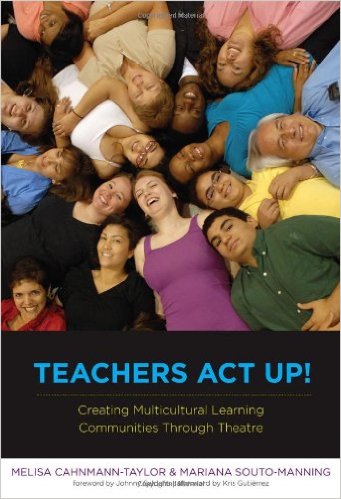
If teachers want to create positive change in the lives of their students, then they must first be able to create positive change in their own lives. This book describes a powerful professional development approach that merges the scholarship of critical pedagogy with the Theatre of the Oppressed. Participants “act up” in order to explore real-life scenarios and rehearse difficult conversations they are likely to have with colleagues, students, administrators, and parents. The authors have practiced the theatrical strategies presented here with pre- and in-service teachers in numerous contexts, including college courses, professional development seminars, and PreK–12 classrooms. They include step-by-step instructions and vivid photographs to help readers use these revolutionary theatre strategies in their own contexts for a truly unique learning experience. (From the Publisher)