Home » Resources » Scholarship on Teaching » Student Learning in College Residence Halls: What Works, What Doesn't, and Why
Scholarship
March 29, 2017
Student Learning in College Residence Halls: What Works, What Doesn’t, and Why
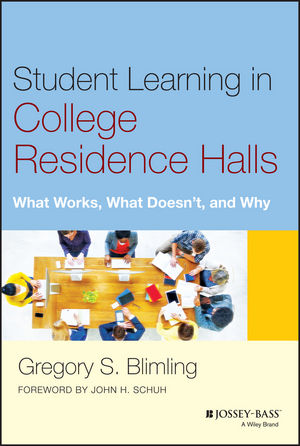
- Author
- Blimling, Gregory S.
- Publisher
- Jossey-Bass, San Francisco, CA
- ISBN
- 9781118551608
- Table of Contents
-
List of Tables and Figures
Foreword
Preface
Acknowledgments
About the Author
ch. 1 The Historical and Philosophical Foundations of Student Learning in Residence Halls
ch. 2 How Biological and Psychological Development Influence Student Learning and Behavior
ch. 3 How Students Learn in Residence Halls
ch. 4 How to Create Learning Environments in Residence Halls
ch. 5 Selecting and Developing Residence Life Staff to Advance Student Learning
ch. 6 How Residential Environments Influence Student Learning
ch. 7 How to Shape the Peer Environment in Residence Halls to Advance Student Learning
ch. 8 Managing Student Life in Residence Halls to Support Student Learning
ch. 9 Assessing and Improving Residence Life Programs
ch. 10 The Future of Residence Halls
References
Name Index
Subject Index
Click Here for Book Review
Abstract: Grounded in current research and practical experience, Student Learning in College Residence Halls: What Works, What Doesn't, and Why shows how to structure the peer environment in residence halls to advance student learning. Focusing on the application of student learning principles, the book examines how neurobiological and psychosocial development influences how students learn in residence halls. The book is filled with examples, useful strategies, practical advice, and best practices for building community and shaping residential environments that produce measureable learning outcomes. Readers will find models for a curriculum-based approach to programming and for developing student staff competencies, as well as an analysis of what types of residential experiences influence student learning. An examination of how to assess student learning in residence halls and of the challenges residence halls face provide readers with insight into how to strategically plan for the future of residence halls as learning centers.
The lack of recent literature on student learning in college residence halls belies the changes that have taken place. More traditional-age students are enrolled in college than ever before, and universities are building more residence halls to meet the increased demand for student housing. This book addresses these developments, reviews contemporary research, and provides up-to-date advice for creating residence hall environments that achieve educationally purposeful outcomes.
• Discover which educational benefits are associated with living in residence halls
• Learn how residential environments influence student behavior
• Create residence hall environments that produce measureable learning outcomes
• Monitor effectiveness with a process of systematic assessment
Residence halls are an integral part of the college experience; with the right programs in place they can become dynamic centers of student learning. Student Learning in College Residence Halls is a comprehensive resource for residence hall professionals and others interested in improving students' learning experience. (From the Publisher)
Abstract: Grounded in current research and practical experience, Student Learning in College Residence Halls: What Works, What Doesn't, and Why shows how to structure the peer environment in residence halls to advance student learning. Focusing on the application of student learning principles, the book examines how neurobiological and psychosocial development influences how students learn in residence halls. The book is filled with examples, useful strategies, practical advice, and best practices for building community and shaping residential environments that produce measureable learning outcomes. Readers will find models for a curriculum-based approach to programming and for developing student staff competencies, as well as an analysis of what types of residential experiences influence student learning. An examination of how to assess student learning in residence halls and of the challenges residence halls face provide readers with insight into how to strategically plan for the future of residence halls as learning centers.
The lack of recent literature on student learning in college residence halls belies the changes that have taken place. More traditional-age students are enrolled in college than ever before, and universities are building more residence halls to meet the increased demand for student housing. This book addresses these developments, reviews contemporary research, and provides up-to-date advice for creating residence hall environments that achieve educationally purposeful outcomes.
• Discover which educational benefits are associated with living in residence halls
• Learn how residential environments influence student behavior
• Create residence hall environments that produce measureable learning outcomes
• Monitor effectiveness with a process of systematic assessment
Residence halls are an integral part of the college experience; with the right programs in place they can become dynamic centers of student learning. Student Learning in College Residence Halls is a comprehensive resource for residence hall professionals and others interested in improving students' learning experience. (From the Publisher)