Home » Resources » Scholarship on Teaching » Small Teaching: Everyday Lessons from the Science of Learning
Scholarship
March 29, 2017
Small Teaching: Everyday Lessons from the Science of Learning
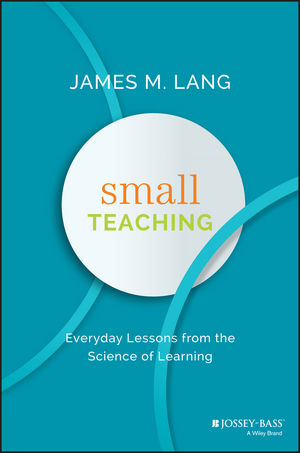
- Author
- Lang, James M.
- Publisher
- John Wiley & Sons, San Francisco, CA
- ISBN
- 9781118944493
- Table of Contents
-
Acknowledgments
About the Author
Introduction: Small Teaching
Part I Knowledge
ch. 1 Retrieving
ch. 2 Predicting
ch. 3 Interleaving
Part II Understanding
ch. 4 Connecting
ch. 5 Practicing
ch. 6 Self-Explaining
Part III Inspiration
ch. 7 Motivating
ch. 8 Growing
ch. 9 Expanding
Conclusion: Beginning
Works Cited
Index
Click Here for Book Review
Abstract: Employ cognitive theory in the classroom every day
Research into how we learn has opened the door for utilizing cognitive theory to facilitate better student learning. But that's easier said than done. Many books about cognitive theory introduce radical but impractical theories, failing to make the connection to the classroom. In Small Teaching, James Lang presents a strategy for improving student learning with a series of modest but powerful changes that make a big difference—many of which can be put into practice in a single class period. These strategies are designed to bridge the chasm between primary research and the classroom environment in a way that can be implemented by any faculty in any discipline, and even integrated into pre-existing teaching techniques. Learn, for example:
- How does one become good at retrieving knowledge from memory?
- How does making predictions now help us learn in the future?
- How do instructors instill fixed or growth mindsets in their students?
Each chapter introduces a basic concept in cognitive theory, explains when and how it should be employed, and provides firm examples of how the intervention has been or could be used in a variety of disciplines. Small teaching techniques include brief classroom or online learning activities, one-time interventions, and small modifications in course design or communication with students. (From the Publisher)
Abstract: Employ cognitive theory in the classroom every day
Research into how we learn has opened the door for utilizing cognitive theory to facilitate better student learning. But that's easier said than done. Many books about cognitive theory introduce radical but impractical theories, failing to make the connection to the classroom. In Small Teaching, James Lang presents a strategy for improving student learning with a series of modest but powerful changes that make a big difference—many of which can be put into practice in a single class period. These strategies are designed to bridge the chasm between primary research and the classroom environment in a way that can be implemented by any faculty in any discipline, and even integrated into pre-existing teaching techniques. Learn, for example:
- How does one become good at retrieving knowledge from memory?
- How does making predictions now help us learn in the future?
- How do instructors instill fixed or growth mindsets in their students?
Each chapter introduces a basic concept in cognitive theory, explains when and how it should be employed, and provides firm examples of how the intervention has been or could be used in a variety of disciplines. Small teaching techniques include brief classroom or online learning activities, one-time interventions, and small modifications in course design or communication with students. (From the Publisher)