Home » Resources » Scholarship on Teaching » Reach Everyone, Teach Everyone: Universal Design for Learning in Higher Education
Scholarship
November 29, 2018
Reach Everyone, Teach Everyone: Universal Design for Learning in Higher Education
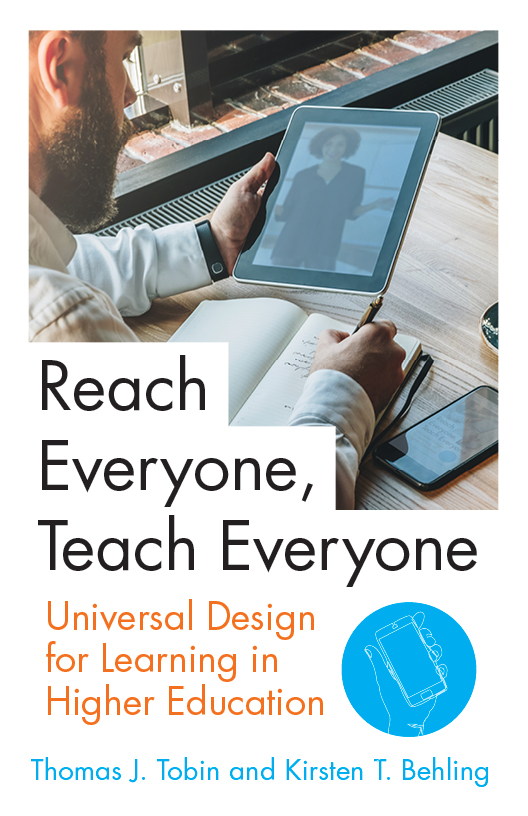
- Author
- Tobin, Thomas J.; Behling, Kirsten T.
- Publisher
- West Virginia University Press
- ISBN
- 9781946684608
- Table of Contents
-
Acknowledgments
Introduction
Part 1 Where We Are Now
Ch 1. How Universal Design for Learning Got to Higher Education
Ch 2. It’s the Law . . . Except When It Isn’t
Part 2 Reframing UDL
Ch 3. Meet the Mobile Learners
Ch 4. Engage Digital Learners
Ch 5. Adopt the Plus-One Approach
Ch 6. Coach the Coaches and the Players
Part 3 Adopt UDL on Your Campus
Ch 7. Expand One Assignment
Ch 8. Enhance One Program: UDL across the Curriculum
Ch 9. Extend to One Modality: The Online Environment
Ch 10. Embrace One Mind-Set: Campuswide UDL
Ch 11. Engage! The UDL Life Cycle
Coda
References
Index
About the Authors
Advocates for the rights of people with disabilities have worked hard to make universal design in the built environment “just part of what we do.” We no longer see curb cuts, for instance, as accommodations for people with disabilities, but perceive their usefulness every time we ride our bikes or push our strollers through crosswalks.
This is also a perfect model for Universal Design for Learning (UDL), a framework grounded in the neuroscience of why, what, and how people learn. Tobin and Behling show that, although it is often associated with students with disabilities, UDL can be profitably broadened toward a larger ease-of-use and general diversity framework. Captioned instructional videos, for example, benefit learners with hearing impairments but also the student who worries about waking her young children at night or those studying on a noisy team bus.
Reach Everyone, Teach Everyone is aimed at faculty members, faculty-service staff, disability support providers, student-service staff, campus leaders, and graduate students who want to strengthen the engagement, interaction, and performance of all college students. It includes resources for readers who want to become UDL experts and advocates: real-world case studies, active-learning techniques, UDL coaching skills, micro- and macro-level UDL-adoption guidance, and use-them-now resources. (From the Publisher)
This is also a perfect model for Universal Design for Learning (UDL), a framework grounded in the neuroscience of why, what, and how people learn. Tobin and Behling show that, although it is often associated with students with disabilities, UDL can be profitably broadened toward a larger ease-of-use and general diversity framework. Captioned instructional videos, for example, benefit learners with hearing impairments but also the student who worries about waking her young children at night or those studying on a noisy team bus.
Reach Everyone, Teach Everyone is aimed at faculty members, faculty-service staff, disability support providers, student-service staff, campus leaders, and graduate students who want to strengthen the engagement, interaction, and performance of all college students. It includes resources for readers who want to become UDL experts and advocates: real-world case studies, active-learning techniques, UDL coaching skills, micro- and macro-level UDL-adoption guidance, and use-them-now resources. (From the Publisher)