Home » Resources » Scholarship on Teaching » Race, Poverty, and Social Justice: Multidisciplinary Perspectives Through Service Learning
Scholarship
March 29, 2017
Race, Poverty, and Social Justice: Multidisciplinary Perspectives Through Service Learning
- Author
- Calderón, Jose Z.; Eisman , Gerald; and Corrigan , Robert A., eds.
- Publisher
- Stylus Publishing, LLC, Sterling, VA
- ISBN
- 9781579222208
- Table of Contents
-
Foreword
About This Series
Introduction
Activity/Methodology Table
List of Contributors
Section I: Foundations of Service Learning and Social Justice
ch. 1 Advancing Service Learning as a Transformative Method for Social Justice Work (Robert Stanley Oden, Thomas Amar Casey)
ch. 2 Stimulating Social Justice Theory for Service Learning Practice (David Schulz)
ch. 3 Reflections on Service Learning as a Pedagogical Strategy in Composition Christine Popok)
Section II: The Day Labor Project
ch. 4 Linking Critical Democratic Pedagogy, Multiculturalism, and Service Learning to a Project-Based Approach (Jose Z. Calderon, Gilbert Cadena)
ch. 5 Designing a Safety Program for Day Laborers (Edward V. Clancy)
ch. 6 Community-Based Scholarship: Nutrition Students Learn Spanish in the Classroom and at the City of Pomona Day Labor Center (Susan Algert)
Section III: Social Policy and Homelessness
ch. 7 Social Justice and Public Policy (Roberta Ann Johnson, Robert C. Chope)
ch. 8 Social Responsibility by Design: Interior Design, Graphic Design and Photography Students’ Close Encounter with Homelessness (Jill Pable)
ch. 9 Providing Human Services with a Social Justice Perspective (Robert C. Chope, Rebecca L. Toporek)
Section IV: International Project
ch. 10 Service Learning in the World Community: Video Production in South America (Betsy J. Blosser)
Section V: Culture and Equity
ch. 11 Creating Social Justice in the Classroom: Preparing Students for Diversity through Service-Learning (Tasha Souza)
ch. 12 Social Justice and Community Service Learning in Chicano/Latino/Raza Studies (Velia Garcia)
ch. 13 Reclaiming a Forgotten Past: The San Fernando Valley Japanese American Oral History and Photograph Collection Project (Edith Wen-Chu)
ch. 14 Cultural Issues in American Indian Education
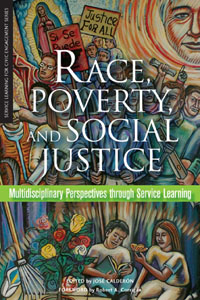
This volume explores multiple examples of how to connect classrooms to communities through service learning and participatory research to teach issues of social justice. The various chapters provide examples of how collaborations between students, faculty, and community partners are creating models of democratic spaces (on campus and off campus) where the students are teachers and the teachers are students. The purpose of this volume is to provide examples of how service learning can be integrated into courses addressing social justice issues. At the same time, it is about demonstrating the power of service learning in advancing a course content that is community-based and socially engaged.
To stimulate the adaptation of the approaches described in these books, each volume includes an Activity / Methodology table that summarizes key elements of each example, such as class size, pedagogy, and other disciplinary applications. Click here for the table to this title. (From the Publisher)
To stimulate the adaptation of the approaches described in these books, each volume includes an Activity / Methodology table that summarizes key elements of each example, such as class size, pedagogy, and other disciplinary applications. Click here for the table to this title. (From the Publisher)