Home » Resources » Scholarship on Teaching » Publicly Engaged Scholars: Next-Generation Engagement and the Future of Higher Education
Scholarship
March 29, 2017
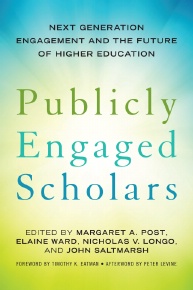
Publicly Engaged Scholars: Next-Generation Engagement and the Future of Higher Education
- Author
- Post, Margaret A.; Ward, Elaine; Longo, Nicholas V.; Satlmarsh, John, eds.
- Publisher
- Stylus, Sterling, VA
- ISBN
- 9781620362648
- Table of Contents
-
Forward (Timothy K. Eatman)
Preface
Acknowledgments
ch. 1 Introducing Next-Generation Engagement (Margaret A. Post, Elaine Ward, Nicholas V. Longo, and John Saltmarsh)
Part One: The Collaborative Engagement Paradigm
ch. 2 The Inheritance of Next Generation Engagement Scholars (John Saltmarsh and Matthew Hartley)
ch. 3 A Brief History of a Movement - Civic Engagement and American Higher Education (Matthew Hartley and John Saltmarsh)
ch. 4 Collaborative Engagement—The Future of Teaching and Learning in Higher Education (Nicholas V. Longo and Cynthia M. Gibson)
ch. 5 Collaborative Engagement Research and Implications for Institutional Change (Farrah Jacquez, Elaine Ward, and Molly Goguen)
ch. 6 Legitimacy, Agency, and Inequality - Organizational Practices for Full Participation of Community Engaged Faculty (KerryAnn O’Meara)
Part Two: New Public Scholars
Opening (Elaine Ward)
ch. 7 Disrupting Role Dichotomies (Lina Dostillio, Emily Janke, Margaret A. Post, Annie Miller, and Elaine Ward)
ch. 8 Developing a Community-Engaged Scholarly Identity (Katie Beck, Adam Bush, Lorena Holguin, Demetri Morgan, and Cecilia Orphan)
ch. 9 Paving New Professional Pathways for Community Engaged Scholarship (Patrick Green, Barbara Harrison, Jessica Reading, and Timothy Shaffer)
ch. 10 Critical Commitments to Community and Campus Change (Eric Hartman, Glennys Sanchez, Sabina Shakya, and Brandon Whitney)
ch. 11 Fortunate accidents and winding pathways – The personal and professional spaces of authenticity (Ben Anderson-Nathe, Farrah Jacquez, Rachael Kerns-Wetherington, and Tania D. Mitchell)
ch. 12 Next Generation Engaged Scholars – Stewards of Change (Elaine Ward and Annie Miller)
Part Three: The Future of Engagement
ch. 13 The Future of the Academy with Students as Colleagues (Nicholas V. Longo, Abby Kiesa, and Richard Battistoni)
ch. 14 Next Generation Engagement Scholars in the Neoliberal University (Cecilia M. Orphan and KerryAnn O’Meara)
ch. 15 Building an Organizational Structure that Fosters Blended Engagement (Byron P. White)
Afterword: Practice and Theory in the Service of Social Change (Peter Levine)
About the Authors
Index
Click Here for Book Review
Abstract: The concern that the democratic purposes of higher education -- and its conception as a public good -- are being undermined, with the growing realization that existing structures are unsuited to addressing today's complex societal problems, and that our institutions are failing an increasingly diverse population, all give rise to questioning the current model of the university.
This book presents the voices of a new generation of scholars, educators, and practitioners who are committed to civic renewal and the public purposes of higher education. They question existing policies, structures, and practices, and put forward new forms of engagement that can help to shape and transform higher education to align it with societal needs.
The scholars featured in this book make the case for public scholarship and argue that, in order to strengthen the democratic purposes of higher education for a viable future that is relevant to the needs of a changing society, we must recognize and support new models of teaching and research, and the need for fundamental changes in the core practices, policies, and cultures of the academy.
These scholars act on their values through collaboration, inclusiveness, participation, task sharing, and reciprocity in public problem solving. Central to their approach is an authentic respect for the expertise and experience that all stakeholders contribute to education, knowledge generation, and community building.
This book offers a vision of the university as a part of an ecosystem of knowledge production, addressing public problems with the purpose of advancing a more inclusive, deliberative democracy; and explores the new paradigm for teaching, learning, and knowledge creation necessary to make it a reality. (From the Publisher)
Abstract: The concern that the democratic purposes of higher education -- and its conception as a public good -- are being undermined, with the growing realization that existing structures are unsuited to addressing today's complex societal problems, and that our institutions are failing an increasingly diverse population, all give rise to questioning the current model of the university.
This book presents the voices of a new generation of scholars, educators, and practitioners who are committed to civic renewal and the public purposes of higher education. They question existing policies, structures, and practices, and put forward new forms of engagement that can help to shape and transform higher education to align it with societal needs.
The scholars featured in this book make the case for public scholarship and argue that, in order to strengthen the democratic purposes of higher education for a viable future that is relevant to the needs of a changing society, we must recognize and support new models of teaching and research, and the need for fundamental changes in the core practices, policies, and cultures of the academy.
These scholars act on their values through collaboration, inclusiveness, participation, task sharing, and reciprocity in public problem solving. Central to their approach is an authentic respect for the expertise and experience that all stakeholders contribute to education, knowledge generation, and community building.
This book offers a vision of the university as a part of an ecosystem of knowledge production, addressing public problems with the purpose of advancing a more inclusive, deliberative democracy; and explores the new paradigm for teaching, learning, and knowledge creation necessary to make it a reality. (From the Publisher)