Home » Resources » Scholarship on Teaching » Protocols in the Classroom: Tools to Help Students Read, Write, Think, and Collaborate
Scholarship
September 19, 2018
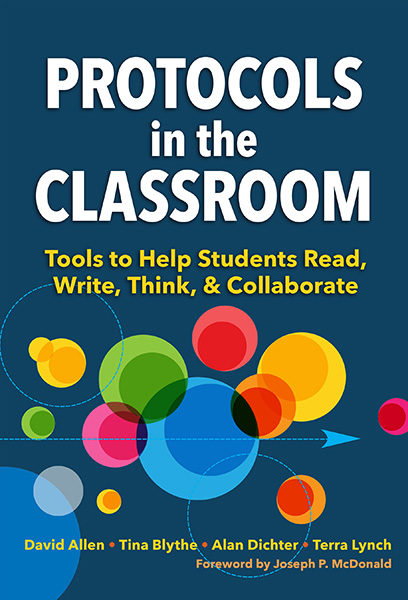
Protocols in the Classroom: Tools to Help Students Read, Write, Think, and Collaborate
- Author
- Allen, David; Blythe, Tina; Dichter, Alan; Lynch, Terra
- Publisher
- Teachers College Press
- ISBN
- 9780807759042
- Table of Contents
-
Foreword by Joseph P. McDonald
Acknowledgments
Introduction
What Is a Protocol?
Why Use Protocols?
How Is This Book Organized?
How Might You Use This Book?
PART I: GETTING GOING WITH PROTOCOLS
Chapter 1. Choosing a Protocol
How Well Do Your Students Know One Another?
How Familiar Are Your Students with Protocols?
What Are Your Learning Objectives for Students?
What Habits Do You Want Students to Develop?
What Are Your Students' Strengths and Needs?
How Much Time Do You Have with Your Students?
Chapter 2. Facilitating the Protocol
Preparing for the Protocol
Introducing the Protocol
Guiding the Protocol
Closing the Protocol
Chapter 3. Building Buy-In and Practicing Habits
All-Purpose Go-Round
Connections
Postcards
3-2-1
Turn & Talk (also known as Pair–Share)
Warm & Cool
PART II: THE PROTOCOLS
Reflecting on Styles, Preferences, and Expectations
Chapter 4. Compass Points
Purposes and Preparation
Steps of the Protocol
Tips for Facilitating the Protocol
Compass Points in the Classroom
Chapter 5. Fears and Hopes
Purposes and Preparation
Steps of the Protocol
Tips for Facilitating the Protocol
Fears and Hopes in the Classroom
Exploring Questions
Chapter 6. Microlab
Purposes and Preparation
Steps of the Protocol
Tips for Facilitating the Protocol
Microlab in the Classroom
Chapter 7. Chalk Talk
Purposes and Preparation
Steps of the Protocol
Tips for Facilitating the Protocol
Chalk Talk in the Classroom
Chapter 8. Peeling the Onion
Purposes and Preparation
Steps of the Protocol
Tips for Facilitating the Protocol
Peeling the Onion in the Classroom
Entering and Engaging with Texts
Chapter 9. Text Rendering Experience
Purposes and Preparation
Steps of the Protocol
Tips for Facilitating the Protocol
Text Rendering Experience in the Classroom
Chapter 10. Save the Last Word for Me
Purposes and Preparation
Steps of the Protocol
Tips for Facilitating the Protocol
Save the Last Word for Me in the Classroom
Chapter 11. Three Levels of Text
Purposes and Preparation
Steps of the Protocol
Tips for Facilitating the Protocol
Three Levels of Text in the Classroom
Chapter 12. Gallery Walk
Purposes and Preparation
Steps of the Protocol
Tips for Facilitating the Protocol
Gallery Walk in the Classroom
Giving and Receiving Feedback
Chapter 13. Ladder of Feedback
Purposes and Preparation
Steps of the Protocol
Tips for Facilitating the Protocol
Ladder of Feedback in the Classroom
Chapter 14. Tuning Protocol
Purposes and Preparation
Steps of the Protocol
Tips for Facilitating the Protocol
Tuning Protocol in the Classroom
PART III: GETTING BETTER WITH PROTOCOLS
Chapter 15. Getting the Most Out of the Debrief
Questions for Debriefing Protocols
Challenges in Debriefing Protocols
Chapter 16. Documenting and Deepening the Learning
Documenting Student Learning in Protocols
Using Documentation to Deepen Learning
Chapter 17. Troubleshooting During the Protocol
Challenge: Some Students Are Talking a Lot—Others, Not at All Challenge: No One Is Talking
Challenge: Sticking with a Specific Step of the Protocol
Challenge: Offering Feedback in a Respectful Way
Challenge: Feedback Isn't Very Substantive
Chapter 18. Relating Protocols to Other Practices
Accountable Talk
The Fishbowl
The Jigsaw
Restorative Practices: Classroom Circles
Socratic Seminar
Thinking Routines
Afterword: A Schoolwide Culture of Discussion, Inquiry, and Reflection
Resources
Using Protocols in Professional Development and Meetings Using Protocols in the Classroom
Related Practices
Click Here for Book Review
For nearly 2 decades, Looking Together at Student Work and The Power of Protocols have sustained educators in their professional learning. Protocols in the Classroom expands the scope of those books from teachers’ professional learning to include students' learning, providing teachers with the tools they need to use discussion protocols to support students in developing crucial skills and habits as readers, writers, critical thinkers, and active participants within the classroom community. This essential guide provides detailed descriptions of protocols for four critical purposes:
-Entering into and engaging with texts of many different types;
-Sharing perspectives on questions, issues, or topics;
-Giving and receiving important feedback on works in progress;
-Exploring one’s own unique learning style.
For each protocol the authors provide a clear set of steps, tips for teachers and students in facilitating the protocol, and a story of a teacher using the protocol with students. The book is filled with resources for getting started using protocols with students, as well as for deepening the use of protocols over time. It also relates protocols to other strategies for supporting students’ learning, including Accountable Talk, Thinking Routines, and Socratic seminars. The authors describe how protocols contribute to a schoolwide culture of discussion, inquiry, and reflection. (From the Publisher)
For nearly 2 decades, Looking Together at Student Work and The Power of Protocols have sustained educators in their professional learning. Protocols in the Classroom expands the scope of those books from teachers’ professional learning to include students' learning, providing teachers with the tools they need to use discussion protocols to support students in developing crucial skills and habits as readers, writers, critical thinkers, and active participants within the classroom community. This essential guide provides detailed descriptions of protocols for four critical purposes:
-Entering into and engaging with texts of many different types;
-Sharing perspectives on questions, issues, or topics;
-Giving and receiving important feedback on works in progress;
-Exploring one’s own unique learning style.
For each protocol the authors provide a clear set of steps, tips for teachers and students in facilitating the protocol, and a story of a teacher using the protocol with students. The book is filled with resources for getting started using protocols with students, as well as for deepening the use of protocols over time. It also relates protocols to other strategies for supporting students’ learning, including Accountable Talk, Thinking Routines, and Socratic seminars. The authors describe how protocols contribute to a schoolwide culture of discussion, inquiry, and reflection. (From the Publisher)