Home » Resources » Scholarship on Teaching » Proleptic Pedagogy: Theological Education Anticipating the Future
Scholarship
March 29, 2017
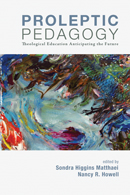
Proleptic Pedagogy: Theological Education Anticipating the Future
- Author
- Matthaei, Sondra Higgins; and Howell, Nancy R., eds.
- Publisher
- Wipf & Stock Publishers, Eugene, OR
- ISBN
- 9781620324387
- Table of Contents
-
List of Contributors
ch. 1 Proleptic Pedagogy, Transition, and Teaching toward the Future: An Introduction (Nancy R. Howell)
ch. 2 Proleptic Pedagogy, Pluralism, and Pedagogical Agility (Nancy R. Howell)
ch. 3 From Objectifying to Contemplating the Other: An Incarnational Approach to Pedagogy in Theological Education (Robert Martin)
ch. 4 Student Formation through Experiential and Transformative Learning: Pedagogical Insights from/for Contextual Education (James M. Brandt)
ch. 5 Immediacy: The Intersection of Technological and Face-to-face Modalities in Educating a Younger Generation (Claire Annelise Smith)
ch. 6 Teaching Integrative Theological Reflection as a Way of Life (Nancy R. Howell, and F. Douglas Powe Jr.)
ch. 7 Pedagogical Issues ion Theological Education for Diverse Peoples and Divergent Thinkers (Sondra Higgins Matthaei with Jami Moss)
ch. 8 Hip-Hop in the Classroom (F. Douglas Powe, Jr.)
Bibliography
Index
Click Here for Book Review
Abstract: Could we have imagined how much theological education would change in the new millennium? Shifting needs of students, classrooms, and churches have demanded constant revisions of the curriculum, course design, classroom technology, and pedagogical strategies.
Saint Paul School of Theology felt the tide of change within our own walls and designed a project called "Proleptic Pedagogy" to address three distinct pedagogical challenges for the future of theological education. First, instead of fitting new technologies into old pedagogies, how are teaching and learning transformed by shifting needs of students who are "digital natives," "digital immigrants," or distance learners? Second, instead of reactive strategies, what pedagogy proactively eliminates "accommodations" because courses are designed with flexibility and openness to diverse learning styles, disabilities, and needs? Third, instead of engaging student diversity with the tools of the 1960s, what new teaching and learning strategies anticipate future student racial and ethnic demographics and interracial educational experiences?
This volume of essays narrates our classroom stories, teases out pedagogical issues, examines pedagogical literature, reflects on theology of pedagogy, and constructs pedagogical proposals—with an open invitation for other theological educators to join our conversation about the future of theological education. (From the Publisher)
Abstract: Could we have imagined how much theological education would change in the new millennium? Shifting needs of students, classrooms, and churches have demanded constant revisions of the curriculum, course design, classroom technology, and pedagogical strategies.
Saint Paul School of Theology felt the tide of change within our own walls and designed a project called "Proleptic Pedagogy" to address three distinct pedagogical challenges for the future of theological education. First, instead of fitting new technologies into old pedagogies, how are teaching and learning transformed by shifting needs of students who are "digital natives," "digital immigrants," or distance learners? Second, instead of reactive strategies, what pedagogy proactively eliminates "accommodations" because courses are designed with flexibility and openness to diverse learning styles, disabilities, and needs? Third, instead of engaging student diversity with the tools of the 1960s, what new teaching and learning strategies anticipate future student racial and ethnic demographics and interracial educational experiences?
This volume of essays narrates our classroom stories, teases out pedagogical issues, examines pedagogical literature, reflects on theology of pedagogy, and constructs pedagogical proposals—with an open invitation for other theological educators to join our conversation about the future of theological education. (From the Publisher)