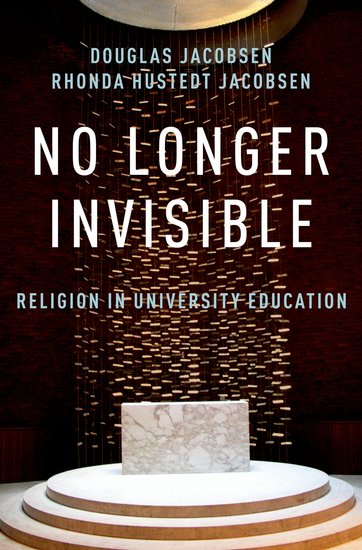
- Author
- Jacobsen, Rhonda Hustedt, and Jacobsen, Douglas
- Publisher
- Oxford University Press, Oxford, NY
- ISBN
- 9780199844739
- Book Review Link
- http://onlinelibrary.wiley.com/doi/10.1111/teth.12087/abstract
- Table of Contents
-
Introduction: Religion within Higher Education
Part I: Context
ch. 1. Religion's ''Return''
ch. 2. The History of Religion in American Higher Education
ch. 3. Trail Markers in a Time of Transition
ch. 4. A Framework for Better Questions
Part II: Content
ch. 5. Religious Literacy
ch. 6. Interfaith Etiquette
ch. 7. Framing Knowledge
ch. 8. Civic Engagement
ch. 9. Convictions
ch. 10. Character and Vocation
Drawing on conversations with hundreds of professors, co-curricular educators, administrators, and students from institutions spanning the entire spectrum of American colleges and universities, the Jacobsens illustrate how religion is constructively intertwined with the work of higher education in the twenty-first century. No Longer Invisible documents how, after decades when religion was marginalized, colleges and universities are re-engaging matters of faith-an educational development that is both positive and necessary.
Religion in contemporary American life is now incredibly complex, with religious pluralism on the rise and the categories of "religious" and "secular" often blending together in a dizzying array of lifestyles and beliefs. Using the categories of historic religion, public religion, and personal religion, No Longer Invisible offers a new framework for understanding this emerging religious terrain, a framework that can help colleges and universities-and the students who attend them-interact with religion more effectively. The stakes are high: Faced with escalating pressures to focus solely on job training, American higher education may find that paying more careful and nuanced attention to religion is a prerequisite for preserving American higher education's longstanding commitment to personal, social, and civic learning. (From the Publisher)
Religion in contemporary American life is now incredibly complex, with religious pluralism on the rise and the categories of "religious" and "secular" often blending together in a dizzying array of lifestyles and beliefs. Using the categories of historic religion, public religion, and personal religion, No Longer Invisible offers a new framework for understanding this emerging religious terrain, a framework that can help colleges and universities-and the students who attend them-interact with religion more effectively. The stakes are high: Faced with escalating pressures to focus solely on job training, American higher education may find that paying more careful and nuanced attention to religion is a prerequisite for preserving American higher education's longstanding commitment to personal, social, and civic learning. (From the Publisher)