Home » Resources » Scholarship on Teaching » Modeling Mentoring Across Race/Ethnicity and Gender: Practices to Cultivate the Next Generation of Diverse Faculty
Scholarship
March 29, 2017
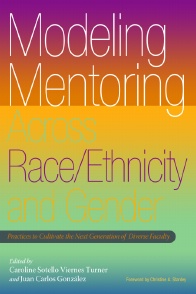
Modeling Mentoring Across Race/Ethnicity and Gender: Practices to Cultivate the Next Generation of Diverse Faculty
- Author
- Turner, Caroline Sotello Viernes; and Gonz√°lez, Juan Carlos, eds.
- Publisher
- Stylus, Sterling, VA
- ISBN
- 9781579224882
- Table of Contents
-
Foreword (Christine A. Stanley)
Preface (Caroline Sotello Viernes Turner)
ch. 1 What Does The Literature Tell Us About Mentoring Across Race/Ethnicity and Gender? (Caroline Sotello Viernes Turner and Juan Carlos Gonz√°lez)
ch. 2 Building Cross-Gender Mentorship in Academe: A Chicano-Latina/Filipina Relationship Built on Common Scholarly Commitments (Juan Carlos Gonz√°lez and Caroline Sotello Viernes Turner)
ch. 3 Socialization in Academe: Reflections on Mentoring by a Latina-Filipina Mentor and an African American Male Protégé (J. Luke Wood and Caroline Sotello Viernes Turner)
ch. 4 Breaking Through Racial and Gender Barriers: Reflections on Dissertation Mentorship and Peer Support (Edward P. St. John, O. Cleveland Hill, Ontario S. Wooden, and Penny A. Pasque)
ch. 5 Latina Faculty and Latino Male Student Mentorship Processes: Aprendiendo y Compartiendo Juntos (Jeanett Castellanos and Mark A. Kamimura-Jiménez)
ch. 6 A Critical Race Journey of Mentoring (Dimpal Jain and Daniel Solorzano)
ch. 7 Cross-Gender Mentoring From a Caribbean Perspective (Christine A. Stanley and Dave A. Louis)
ch. 8 Autoethnography/Testimonio, Common Sense Racism, and the Politics of Cross-Gender Mentoring (Elvia Romero and Alfredo Mirandé)
ch. 9 Anaalysis of the Mentor-Protégé Narratives: Reflecting The Literature (Juan Carlos González and Caroline Sotello Viernes Turner)
ch. 10 Analysis of the Mentor-Protégé Narratives: Contributing To The Literature and Emerging Mentoring Model for Practice (Caroline Sotello Viernes Turner and Juan Carlos González)
About the Editors
About the Authors
Index
While mentorship has been shown to be critical in helping graduate students persist and complete their studies, and enter upon and succeed in their academic careers, the under-representation of faculty of color and women in higher education greatly reduces the opportunities for graduate students from these selfsame groups to find mentors of their race, ethnicity or gender.
Recognizing that mentoring across gender, race and ethnicity inserts levels of complexity to this important process, this book both fills a major gap in the literature and provides an in-depth look at successful mentorships between senior white and under-represented scholars and emerging women scholars and scholars of color.
Following a comprehensive review of the literature, this book presents chapters written by scholars who share in-depth descriptions of their cross-gender and/or cross-race/ethnicity mentoring relationships. Each article is co-authored by mentors who are established senior scholars and their former protégés with whom they have continuing collegial relationships. Their descriptions provide rich insights into the importance of these relationships, and for developing the academic pipeline for women scholars and scholars of color.
Drawing on a comparative analysis of the literature and of the narrative chapters, the editors conclude by identifying the key characteristics and pathways for developing successful mentoring relationships across race, ethnicity or gender, and by offering recommendations for institutional policy and individual mentoring practice. For administrators and faculty concerned about diversity in graduate programs and academic departments, they offer clear models of how to nurture the productive scholars and teachers needed for tomorrow’s demographic of students; for under-represented students, they offer compelling narratives about the rewards and challenges of good mentorship to inform their expectations and the relationships they will develop as protégés. (From the Publisher)
Recognizing that mentoring across gender, race and ethnicity inserts levels of complexity to this important process, this book both fills a major gap in the literature and provides an in-depth look at successful mentorships between senior white and under-represented scholars and emerging women scholars and scholars of color.
Following a comprehensive review of the literature, this book presents chapters written by scholars who share in-depth descriptions of their cross-gender and/or cross-race/ethnicity mentoring relationships. Each article is co-authored by mentors who are established senior scholars and their former protégés with whom they have continuing collegial relationships. Their descriptions provide rich insights into the importance of these relationships, and for developing the academic pipeline for women scholars and scholars of color.
Drawing on a comparative analysis of the literature and of the narrative chapters, the editors conclude by identifying the key characteristics and pathways for developing successful mentoring relationships across race, ethnicity or gender, and by offering recommendations for institutional policy and individual mentoring practice. For administrators and faculty concerned about diversity in graduate programs and academic departments, they offer clear models of how to nurture the productive scholars and teachers needed for tomorrow’s demographic of students; for under-represented students, they offer compelling narratives about the rewards and challenges of good mentorship to inform their expectations and the relationships they will develop as protégés. (From the Publisher)