Home » Resources » Scholarship on Teaching » Meditation and the Classroom: Contemplative Pedagogy for Religious Studies
Scholarship
March 29, 2017
Meditation and the Classroom: Contemplative Pedagogy for Religious Studies
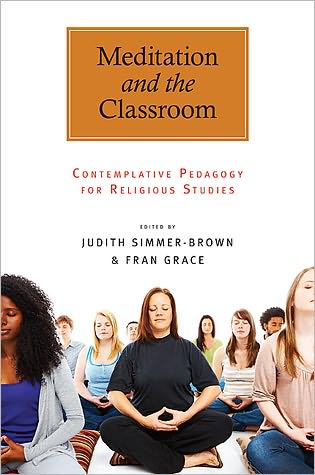
- Author
- Simmer-Brown, Judith, and Grace, Fran
- Publisher
- SUNY Press, Albany, NY
- ISBN
- 9781438437880
- Table of Contents
-
Acknowledgments
Editors’ Introduction
I. Why Contemplatives Pedagogy? The Religious Studies Dialogue
ch. 1 The Convergence of Liberal Education and Contemplative Education—Inevitable?
ch. 2 Meditation and Education: India, Tibet, and Modern America
ch. 3 Contemplative Studies: Can It Flourish in the Religious Studies Classrom?
ch. 4 Contemplative Studies and the Art of Persuasion: The Institutional Challenge
II. The Contemplative Professor
ch. 5 From Content, to Context, to Contemplation: One Professor’s Journey
ch. 6 The Collective Dynamics of Contemplative Practice
ch. 7 The Mindful Teacher as the Foundation of Contemplative Pedagogy
ch. 8 Compassion Beyond Fatigue: Contemplative Training for Educators and Other Helping Professionals
ch. 9 Field Notes from a Daoist Professor
III. Critical Issues In Contemplative Teaching
ch. 10 Training the Heart Responsibly: Ethical Considerations in Contemplative Teaching
ch. 11 Invitation and Coercion in Contemplative Pedagogy
ch. 12 Interiority and Higher Education: The Neurophenomenology of Contemplation
IV. Contemplative-Based Courses
ch. 13 Embodied Contemplative Learning: Aikido as a Case Study
ch. 14 Reflections on Theory and Practice: The Case of Modern Yoga
ch. 15 Sustaining Life: Contemplative Pedagogies in a Religion and Ecology Course
ch. 16 Adab: Courteous Behavior in the Classroom
ch. 17 Experiencing Medieval Christian Spirituality
V. Contemplative Exercises For The Classroom
ch. 18 Awareness Practices in an Undergraduate Buddhism Course
ch. 19 Contemplative Inquiry: Beyond the Disembodied Subject
ch. 20 Love of Wisdom Puts You on the Spot: The Warrior Exam
ch. 21 A Meeting of the Minds in Cyberspace: Eco-contemplative Methods for Online Teaching
ch. 22 Mindfulness in the History Classroom: Teaching as Interbeing
ch. 23 Two Contemplative Practices That Animate the Study of Religion
ch. 24 Mindfulness and Contemplative Practice in Art and Religion
VI. Conclusion: Does It Work? Evaluations From Our Students
ch. 25 Emotional Learning: Re-cognizing Emotion and Thought in a Buddhism Course
ch. 26 Meditation in the Classroom: What Do the Students Say They Learn?
Selected Bibliography List of Contributors Index
A groundbreaking book on using meditation in education and how it can enhance teaching and learning.
Meditation and the Classroom inventively articulates how educators can use meditation to educate the whole student. Notably, a number of universities have initiated contemplative studies options and others have opened contemplative spaces. This represents an attempt to address the inner life. It is also a sign of a new era, one in which the United States is more spiritually diverse than ever before. Examples from university classrooms and statements by students indicate benefits include increased self-awareness, creativity, and compassion.
The religious studies scholars who have contributed to this book often teach about meditation, but here they include reflections on how meditation has affected them and their teaching. Until recently, though, even many religious studies professors would find sharing meditation experiences, let alone teaching meditation techniques, a breach of disciplinary and academic protocols. The value of teaching meditation and teaching about meditation is discussed. Ethical issues such as pluralism, respect, qualifications, power and coercion, and avoiding actual or perceived proselytization are also examined. While methods for religious studies are emphasized, the book provides valuable guidance for all those interested in this endeavor. (From the Publisher)
Meditation and the Classroom inventively articulates how educators can use meditation to educate the whole student. Notably, a number of universities have initiated contemplative studies options and others have opened contemplative spaces. This represents an attempt to address the inner life. It is also a sign of a new era, one in which the United States is more spiritually diverse than ever before. Examples from university classrooms and statements by students indicate benefits include increased self-awareness, creativity, and compassion.
The religious studies scholars who have contributed to this book often teach about meditation, but here they include reflections on how meditation has affected them and their teaching. Until recently, though, even many religious studies professors would find sharing meditation experiences, let alone teaching meditation techniques, a breach of disciplinary and academic protocols. The value of teaching meditation and teaching about meditation is discussed. Ethical issues such as pluralism, respect, qualifications, power and coercion, and avoiding actual or perceived proselytization are also examined. While methods for religious studies are emphasized, the book provides valuable guidance for all those interested in this endeavor. (From the Publisher)