Home » Resources » Scholarship on Teaching » Me-Search and Re-Search: A Guide for Writing Scholarly Personal Narrative Manuscripts
Scholarship
March 29, 2017
Me-Search and Re-Search: A Guide for Writing Scholarly Personal Narrative Manuscripts
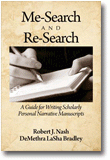
- Author
- Nash, Robert, and Bradley, DeMethra LaSha
- Publisher
- Information Age Publishing, Charlotte, NC
- ISBN
- 9781617353932
- Table of Contents
-
Foreword
Preface
Part I: Setting The Stage For Writing An Spin
ch. 1 What Our Book Is About
ch. 2 Why Can’t I Write More Personally, More Honestly?
ch. 3 Autoethnographies, Memoirs, Personal Narrative Essays, Autobiographies
ch. 4 Okay Then! What Exactly Is Scholarly Personal Narrative Writing?
Part II: The Four Components of Spn: Pre-Search, Me-Search, Re-Search, We-Search
ch. 5 How Do You Get Started?
ch. 6 DeMethra’s Pre-Search Dissertation Process
ch. 7 Speaking to All the Me-Search Self-Doubters
ch. 8 Tell Your Story, Speak Your Truth
ch. 9 The SPN Way to Think About Research
ch. 10 The Relationship of Art to Truth in SPN Writing
ch. 11 The Centrality of Theme-Search in SPN Research
ch. 12 Moving from the Pre-, the Me-, and the Re-, to the We
ch. 13 DeMethra’s Use of We-Search and Universalizability in Her Dissertation
Part III: The Nuts and Bolts Spn Toolbox
ch. 14 The Nuts and Bolts Spn Toolbox
Part IV: Additional Resources For Spn Writers
ch. 15 Our SPN Course Syllabus
ch. 16 Putting It All Together
ch. 17 How to Deal with PSPND Syndrome
ch. 18 Creating an SPN Code of Ethics
ch. 19 How to Create Faculty Support for SPN Writing
References
Robert and DeMethra’s book, Me-Searching and Re-Search, has caught my fancy in a number of ways. The book title cleverly captures what SPN is all about—it is about self narratives (the “me-search” part) and about scholarly meaning making (the “re-search” part). This eye-catching title also illuminates the authors’ intent to turn this seemingly intimidating method of self-inquiry into something very accessible and doable. Their jargon-free language is friendly and inviting. Although they don’t intend to make their many methodological tips and tools too prescriptive, their practical suggestions provided in this guide book are, indeed, helpful and useful. I believe that Robert and DeMethra have demonstrated admirable talents as effective educators by unpacking the complex method of SPN writing into bite-sized steps. I am fully convinced that the steps will help both novices, and the experienced researcher, to reach the ultimate height of producing engaging, and scholarly significant, SPN’s. The book is also fun to read. The authors intersperse throughout their own SPN’s, pedagogical insights from their doing and teaching, and real-life stories, in order to illustrate the methodological process, challenges, and triumphs. (From the Publisher)