Home » Resources » Scholarship on Teaching » Liberating Service Learning and the Rest of Higher Education Civic Engagement
Scholarship
March 29, 2017
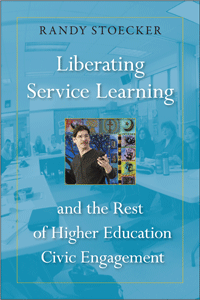
Liberating Service Learning and the Rest of Higher Education Civic Engagement
- Author
- Stoecker, Randy
- Publisher
- Temple University Press, Philadelphia, PA
- ISBN
- 9781439913529
- Table of Contents
-
Prelude: Confessions and Acknowledgments
I The Problem and Its Context

ch. 1 Why I Worry

ch. 2 A Brief Counterintuitive History of Service Learning

ch. 3 Theories (Conscious and Unconscious) of Institutionalized Service Learning
Interlude
II Institutionalized Service Learning

ch. 4 What Is Institutionalized Service Learning's Theory of Learning?

ch. 5 What Is Institutionalized Service Learning's Theory of Service?

ch. 6 What Is Institutionalized Service Learning's Theory of Community?

ch. 7 What Is Institutionalized Service Learning's Theory of Change?
III Liberating Service Learning

ch. 8 Toward a Liberating Theory of Change

ch. 9 Toward a Liberating Theory of Community

ch .10 Toward a Liberating Theory of Service

ch. 11 Toward a Liberating Theory of Learning

ch. 12 Toward a Liberated World?
Postlude
References

Index
Click Here for Book Review
Abstract: Randy Stoecker has been "practicing" forms of community-engaged scholarship, including service learning, for thirty years now, and he readily admits, "Practice does not make perfect." In his highly personal critique, Liberating Service Learning and the Rest of Higher Education Civic Engagement, the author worries about the contradictions, unrealized potential, and unrecognized urgency of the causes as well as the risks and rewards of this work.
Here, Stoecker questions the prioritization and theoretical/philosophical underpinnings of the core concepts of service learning: 1. learning, 2. service, 3. community, and 4. change. By "liberating" service learning, he suggests reversing the prioritization of the concepts, starting with change, then community, then service, and then learning. In doing so, he clarifies the benefits and purpose of this work, arguing that it will create greater pedagogical and community impact.
Liberating Service Learning and the Rest of Higher Education Civic Engagement challenges—and hopefully will change—our thinking about higher education community engagement. (From the Publisher)
Abstract: Randy Stoecker has been "practicing" forms of community-engaged scholarship, including service learning, for thirty years now, and he readily admits, "Practice does not make perfect." In his highly personal critique, Liberating Service Learning and the Rest of Higher Education Civic Engagement, the author worries about the contradictions, unrealized potential, and unrecognized urgency of the causes as well as the risks and rewards of this work.
Here, Stoecker questions the prioritization and theoretical/philosophical underpinnings of the core concepts of service learning: 1. learning, 2. service, 3. community, and 4. change. By "liberating" service learning, he suggests reversing the prioritization of the concepts, starting with change, then community, then service, and then learning. In doing so, he clarifies the benefits and purpose of this work, arguing that it will create greater pedagogical and community impact.
Liberating Service Learning and the Rest of Higher Education Civic Engagement challenges—and hopefully will change—our thinking about higher education community engagement. (From the Publisher)