Home » Resources » Scholarship on Teaching » Knowledge, Difference, and Power: Essays Inspired by Women's Ways of Knowing
Scholarship
March 29, 2017
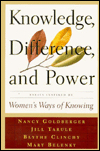
Knowledge, Difference, and Power: Essays Inspired by Women’s Ways of Knowing
- Author
- Goldberger, Nancy, Jill Tarule, Blythe Clinchy, and Mary Belenky, eds.
- Publisher
- Basic Books, New York, NY
- ISBN
- 465090982
- Table of Contents
-
Preface: The Beginning of the Story: Collaboration and Separation
Introduction: Looking Backward, Looking Forward
ch. 1 Reconfiguring Teaching and Knowing in the College Classroom (Ann Stanton)
ch. 2 Women's Ways of "Knowing" Law: Feminist Legal Epistemology, Pedagogy, and Jurisprudence (Carrie Menkel-Meadow)
ch. 3 Embodying Knowledge, Knowing Desire: Authority and Split Subjectivities in Girls' Epistemological Development (Elizabeth Debold, Deborah Tolman, and Lyn Mikel Brown)
ch. 4 Connected Knowing in Constructive Psychotherapy (Michael J. Mahoney)
ch. 5 Women's Ways of Knowing in Women's Studies, Feminist Pedagogies, and Feminist Theory (A. Maher with Mary Kay Tetreault)
ch. 6 Unknown Women and Unknowing Research: Consequences of Color and Class in Feminist Psychology (Vanessa M. Bing and Paela Trotman Reid)
ch. 7 Connected and Separate Knowing: Toward a Marriage of Two Minds (Blythe McVicker Clinchy)
ch. 8 Reason's "Femininity": A Case for Connected Knowing (Sara Ruddick)
ch. 9 Voices in Dialogue: Collaborative Ways of Knowing (Jill Mattuck Tarule)
ch. 10 Speech Is Silver, Silence Is Gold: The Asymmetrical Intersubjectivity of Communicative Action (Patrocinio P. Schweickart)
ch. 11 Cultural Imperatives and Diversity in Ways of Knowing (Nancy Rule Goldberger)
ch. 12 Strategic Suspensions: Feminists of Color Theorize the Production of Knowledge (Ada Hurtado)
ch. 13 Public Homeplaces: Nurturing the Development of People, Families, and Communities (Mary Field Belenky)
ch. 14 Gendered Ways of Knowing and the "Epistemological Crisis" of the West (Sandra Harding)
Contributors
Index
Ten years ago, Mary Belenky, Blythe Clinchy, Nancy Goldberger, and Jill Tarule wrote Women's Ways of Knowing, a book The New York Times Book Review called "a framework for future research on women, knowledge, and identity." In the decade that followed, their theory of women's psychology, development, and ways of knowing has been applied in several fields, from the social sciences to the humanities, women's studies, education, psychology, and law. But even as it was embraced by readers, Women's Ways of Knowing also became the center of a fierce debate within academic circles. Now, in 14 illuminating new essays, the original authors and invited contributors explore how the theory introduced in Women's Ways of Knowing has developed and shifted over the years and how it has been received, applied, used, and abused. The authors, and others, respond to critics of the original theory. The essays also expand the original argument beyond gender and knowing to address the complicating factors of race, class, and culture. (From the Publisher)