Home » Resources » Scholarship on Teaching » It Works for Me, Flipping the Classroom: Shared Tips for Effective Teaching
Scholarship
March 29, 2017
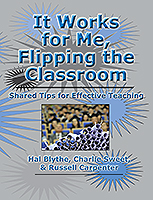
It Works for Me, Flipping the Classroom: Shared Tips for Effective Teaching
- Author
- Blythe, Hal; Sweet, Charlie; and Carpenter, Russell
- Publisher
- New Forums Press, Stillwater, OK
- ISBN
- 9781581072808
- Table of Contents
-
Acknowledgments

Preface

Introduction
ch. 1 PREPARATION FOR THE FLIPPED CLASS EXPERIENCE

To Flip or Not to Flip; Is That My Only Choice?

Start with an Instructional Design Theoretical Construct

Flipping Your Syllabus

Gradual Approach to Flipping

Creating a Personal Welcome for Your Flipped Class

Ultra TLC to Flip without Fizzles and Flops

Effective Integration of Course Syllabus and Online Video Technology to Explain

Student Role in Flipped Classroom Design for Blended Course

Steps for Flipping Your Classroom Using Project Based Learning

Go “Old School” with New Technology

Harness Student Creativity and Expertise

Flipping the Hybrid Classroom Online:  Projects and Conversations

Teaching the Flip:  Facilitating a Professional Learning Community
ch. 2 OUT-OF-CLASS ASSIGNMENTS

Reading Preview Clips

Extending My Classroom Beyond the Classroom Walls with Website Videos

A Multi-Modal Approach to Grammar and Punctuation within a Cultural Setting

Research Reports

Turning Old PowerPoints into Interactive Camtasia Studio Presentations

Stories of the Journey:  Using the Power of Story to Flip This Online Course
ch. 3 IN-CLASS ACTIVITIES

Now That I Flipped, What Do I Do with All This Class Time?

The Half-Flip:  Flipping One Day per Week of a Tuesday-Thursday Class

Class Notes Summary

Practical Simulations for Flipped Classrooms

Luck of the Draw

Using Evolving Case Studies to Deepen Student Learning

Building In-Class Activities through Group Work

An Equal Opportunity Employer:  Delegating Work Assignments to Collaborative Learners

Individual Oral Presentations as an Alternative to Written Answers to Problems

Service Learning and Podcasting PSAs

Community Service Learning and Collaboration in the Classroom Sustained

by Flipping the Classroom

Killing Multiple Birds with a Single Stone:  Using the Flipped Classroom Structure

to Go Beyond Course Content

Teaching Practical Grammar in Foreign Language Studies

Flipping Definitions of Terrorism

Flipping Creativity:  How Pretotyping and Prototyping Facilitate Engaging

Classroom Experiences

Use of the Flipped Classroom for a Super PAC Discussion/Debate

in a Political Science Course

Flipping the Classroom with Video Game Making

Flipped Classroom Student as Teacher: Merchandising Case Studies

Flipping the Online Classroom
ch. 4 ELECTRONIC RESOURCES

The Great Gap

A Public Google Calendar for Coordinating Out-of-Class Content

Engaging Students in Video Outside of Class

TED-Ed Flipped Lessons:  Yes, I Know My Students Are Prepared

Using Animation to Display Course Content
ch. 5 ASSESSMENT OF CLASS EFFECTIVENESS

Blended Classes Relative to Traditional Classes: Perception and Performance Data

Using Voicethread Case Study Design and Peer Analysis Within a Flipped Classroom Model

Using Cognitive Coaching in a Flipped History and Contemporary

Influences of Health, P.E. and Sport Classroom

Flipped Teaching Strategy with Preservice Teachers in a Technology Integration Course
ch. 6 ASSESSMENT OF STUDENT LEARNING

Flipping Assessment in the Flipped Classroom:  Using Bloom’s Taxonomy as a Guide

Flip a Class?  Flip a Test!

Practicing What I Preach:  Flipping for Mastery Learning in Assessment
ch. 7 FOR FURTHER READING AND RESEARCH
Afterword:  Take-Aways

About the Authors
Click Here for Book Review
Abstract: Our primary goal in assembling this collection is to convince faculty to experiment with the “flipped” classroom. Given the techtonic shift, providing educators with an abundance of electronic resources, as well as the nature of today’s students, every faculty member needs to consider the possibilities of the flip.
Now that active learning has been demonstrated by research to be more effective than the pure sage-on-the-stage paradigm, flipping is a natural outgrowth with its recognition that classroom time needs to be dedicated to activities by the instructor, the individual students, and groups that promote a deeper learning of the material.
This book offers a guide for those faculty members wishing to make the first steps, taking the instructor from preparation for the flipped class experience through actual out-of-class assignments, in-class activities, electronic resources available for support, and even assessment of student performance and class effectiveness. (From the Publisher)
Abstract: Our primary goal in assembling this collection is to convince faculty to experiment with the “flipped” classroom. Given the techtonic shift, providing educators with an abundance of electronic resources, as well as the nature of today’s students, every faculty member needs to consider the possibilities of the flip.
Now that active learning has been demonstrated by research to be more effective than the pure sage-on-the-stage paradigm, flipping is a natural outgrowth with its recognition that classroom time needs to be dedicated to activities by the instructor, the individual students, and groups that promote a deeper learning of the material.
This book offers a guide for those faculty members wishing to make the first steps, taking the instructor from preparation for the flipped class experience through actual out-of-class assignments, in-class activities, electronic resources available for support, and even assessment of student performance and class effectiveness. (From the Publisher)