Home » Resources » Scholarship on Teaching » Internationalizing Higher Education: Critical Collaborations across the Curriculum
Scholarship
March 29, 2017
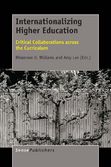
Internationalizing Higher Education: Critical Collaborations across the Curriculum
- Author
- Williams, Rhiannon D.; and Lee, Amy, eds.
- Publisher
- Sense Publishers, The Netherlands
- ISBN
- 9789462099784
- Table of Contents
-
Acknowledgments
Internationalizing Higher Education: Critical Collaborations across the Curriculum (Rhiannon D. Williams and Amy Lee)
Section 1: Mindful Global Citizenship: Critical Concepts and Current Contexts
ch. 1 On the Hologram of International Education: With Raya Hegerman-Davis, Amy Lee, Nue Lor, & Rhiannon Williiams (Josef A. Mestenhauser)
ch. 2 Promoting Holistic Global Citizenship in College: Implications for Education Practitioners (Elena Galinova)
ch. 3 The Challenges and Implications of Globalization for Undergraduate Pedagogy (Marta A. Shaw)
ch. 4 Institutional and Instructional Techniques to Promote Undergraduates’ Intercultural Development: Evidence from a Multi-Institutional Student Survey (Krista M. Soria)
Section 2: Developing Intercultural Programs and Practitioners
ch. 5 Internationalizing Teaching and Learning: Transforming Teachers, Transforming Students (Gayle Woodruff, Kate Martin and Mary Katherine O’Brien)
ch. 6 Strategies for the Development of an Intercultural Environment (Jill E. Blondin)
ch. 7 Global Citizenship: Surfacing the Gap between Rhetoric and Reality in Internationalization of Management Curricula (Diana Rajendra, Janet Bryant, Patricia Buckley and Ryan Jopp)
ch. 8 Social Competencies in the European and Polish Qualifications Framework: A Tool for Designing Intercultural Environments (Ewa Chmielecka and Izabela Buchowicz)
Section 3: Critical Reflections from across the Curriculum
ch. 9 Internationalizing Teaching and Learning in a Graduate Doctor of Nursing Program Curriculum (Mary Benbenek)
ch. 10 Internationalizing College Algebra (Susan Staats)
ch. 11 Illuminating a Course Transformation Journey (Catherine Solheim, Mary Katherine O’Brien and Scott Spicer)
ch. 12 Social Media & Intercultural Competence: Using Each to Explore the Other (Barbara Gibson, Meredith Hyde and Troy Gordon)
ch. 13 Developing Diversity-Related Competences in Creativity Workshop for Teachers (Adam Jagiello-Rusilowski)
ch. 14 On Becoming a Global Citizen: Critical Pedagogy and Crossing Borders in and out of the University Classroom (Sahtiya Hosoda Hammell, Rose Cle, Lauren Start, Chrissie Monaghan and Carol Anne Spreen)
ch. 15 “Unpacking” International Experience through Blended Intercultural Praxis (Jane Jackson)
Notes on Contributors
Click Here for Book Review
Abstract: Higher education is facing unprecedented change as today’s graduates need particular skills, awareness, and knowledge to successfully navigate a complex and interconnected world. Higher education institutions and practitioners are under pressure to be attentive to internationalization initiatives that support increasingly diverse student populations and foster the development of global citizenship competencies which include, “problem-defining and solving perspectives that cross disciplinary and cultural boundaries” (Hudzik, 2004, p. 1 as cited in Leask & Bridge, 2013).
Internationalizing Higher Education: Critical Collaborations across the Curriculum is for current and future faculty, student affairs staff, and administrators from diverse disciplinary, institutional, and geographic contexts. This edited volume invites readers to investigate, better understand, and inform intercultural pedagogy that supports the development of mindful global citizenship. This edited volume features reflective practitioners exploring the dynamic and evolving nature of intercultural learning as well as the tensions and complexities. Contributors include institutional researchers, directors and key implementers of EU/Bologna process in Poland (one of the newest members and one that is facing unprecedented change in the diversity of its students), international partners in learning abroad programs, and scholars and instructors across a range of humanities, STEM, and social sciences. (From the Publisher)
Abstract: Higher education is facing unprecedented change as today’s graduates need particular skills, awareness, and knowledge to successfully navigate a complex and interconnected world. Higher education institutions and practitioners are under pressure to be attentive to internationalization initiatives that support increasingly diverse student populations and foster the development of global citizenship competencies which include, “problem-defining and solving perspectives that cross disciplinary and cultural boundaries” (Hudzik, 2004, p. 1 as cited in Leask & Bridge, 2013).
Internationalizing Higher Education: Critical Collaborations across the Curriculum is for current and future faculty, student affairs staff, and administrators from diverse disciplinary, institutional, and geographic contexts. This edited volume invites readers to investigate, better understand, and inform intercultural pedagogy that supports the development of mindful global citizenship. This edited volume features reflective practitioners exploring the dynamic and evolving nature of intercultural learning as well as the tensions and complexities. Contributors include institutional researchers, directors and key implementers of EU/Bologna process in Poland (one of the newest members and one that is facing unprecedented change in the diversity of its students), international partners in learning abroad programs, and scholars and instructors across a range of humanities, STEM, and social sciences. (From the Publisher)