Home » Resources » Scholarship on Teaching » Interdisciplinary Higher Education: Perspectives and Practicalities
Scholarship
March 29, 2017
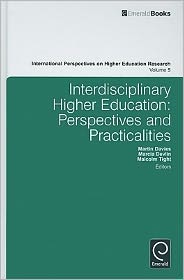
Interdisciplinary Higher Education: Perspectives and Practicalities
- Author
- Davies, Martin, author, ed.; Devlin, Marica, ed.; and Tight, Malcolm, ed.
- Publisher
- Emerald Group Publishing Limited
- ISBN
- 9780857243713
- Book Review Link
- http://onlinelibrary.wiley.com/doi/10.1111/teth.12036/abstract
- Table of Contents
-
List of Contributors
Introduction
Part I: Theoretical Perspectives On Interdisciplinarity
ch. 1 Interdisciplinary Higher Education (Martin Davies, Marcia Devlin)
ch. 2 Complexity and Mastery in Shaping Interdisciplinarity (Philip MacKinnon, William D. Rifkin, Damian Hine, Ross Barnard)
ch. 3 Interdisciplinary Leadership and Learning (Paul Blackmore, Camille Kandiko)
ch. 4 Working Successfully in University Interdisciplinary Teams: Learning From Embedded Intergroup Relations Theory (Meaghan Botterill, Barbara de la Harpe)
ch. 5 What Kind of Interdisciplinary Space Is Academic Development? (Tai Peseta, Catherine Manathunga, Anna Jones)
Part II: Vignettes of Interdisciplinary Practice
Vignette 1 (Inter)disciplinary Dublin Descriptors? Implementation of the Bologna Process in a Dutch University (Ellen Jansen, Martin Goedhart)
Vignette 2 Facing the Realities of Implementing an Interdisciplinary Approach in Institutions of Higher Learning in Malaysia (Sarjit Kaur, Gurnam Kaur Sidhu)
Vignette 3 Interdisciplinary Survival: The Case of Murdoch University (Lorraine Marshall)
Vignette 4 Explicating Interdisciplinarity in a Postgraduate Materials Conversation Programme (Marcelle Scott)
Vignette 5 The Getting of Interdisciplinarity: The Everyday Practice of Environmental Curriculum Design (Ruth Beilin, Helena Bender)
Vignette 6 Pluridisciplinary Learning and Assessment: Reflections on Practice (Sandra Jones, Kim Watty)
Vignette 7 Many Disciplines - Common Approach: Experiences in the Development and Delivery of an Interprofessional Health Subject (Helen Cleak, Dianne Williamson, Glenys French)
Vignette 8 Revisiting Higher Eduction's Heartland: (Inter)Disciplinary Ways of Knowing and Doing For Sustainability Education (Kathryn Hegarty, Barbara de la Harpe )
Vignette 9 Interdisciplinary Scholarship For Novice Students (Charlotte Brack, Lisa Schmidt, Philip MacKinnon)
Vignette 10 The Role of Inter-Faculty Relationships in Special Project Collaborations: A Distinctly New Zealand Experience (Cath Fraser, Lin Ayo)
Vignette 11 Developing Students' Academic Skills: An Interdisciplinary Approach (Kate Chanock)
Vignette 12 Structuring Interdisciplinary Collaboration to Develop Research Students' Skills For Publishing Research Internationally: Lessons From Implementation (Margaret Cargill, Patrick O’Conno)
Vignette 13 Promoting Interdisciplinary Practices Through ePortolios (Juliana Chau)
References Contributors
In an age of pressing global issues such as climate change, the necessity for countries to work together to resolve problems affecting multiple nations has never been more important. Interdisciplinarity in higher education is a key to meeting these challenges. Universities need to produce graduates, and leaders, who understand issues from different perspectives, and who can communicate with others outside the confines of their own disciplines.
Drawing on contributions from 37 scholars from Australia, New Zealand, Hong Kong, Malaysia, the Netherlands and the United Kingdom, this volume examines issues inherent in providing interdisciplinary education within the structures of universities and proposes ways in which these issues might be best managed.
The book has a dual focus on perspectives and practicalities. Themes covered include: the need for graduates who can work within and across multi-disciplinary and multi-professional teams; interdisciplinary leadership; the critical importance of interdisciplinary thinking to meet global challenges; collaboration in interdisciplinary approaches to teaching and learning; the role of institutional and other systems to support interdisciplinary endeavours; the centrality of disciplines; balancing disciplinarity and interdisciplinarity; and the place of interdisciplinarity in graduate outcomes and attributes. Definitional aspects of interdisciplinary higher education and current interdisciplinary practice across a range of contexts are also examined.
Contributors represent a wide range of discipline areas, including accounting, academic development, agriculture, food and wine science, biotechnology, employment relations, environmental science, the health sciences, higher education, land and environment, languages and cultures, occupational therapy, science communication, social work and social policy. (From the Publisher)
Drawing on contributions from 37 scholars from Australia, New Zealand, Hong Kong, Malaysia, the Netherlands and the United Kingdom, this volume examines issues inherent in providing interdisciplinary education within the structures of universities and proposes ways in which these issues might be best managed.
The book has a dual focus on perspectives and practicalities. Themes covered include: the need for graduates who can work within and across multi-disciplinary and multi-professional teams; interdisciplinary leadership; the critical importance of interdisciplinary thinking to meet global challenges; collaboration in interdisciplinary approaches to teaching and learning; the role of institutional and other systems to support interdisciplinary endeavours; the centrality of disciplines; balancing disciplinarity and interdisciplinarity; and the place of interdisciplinarity in graduate outcomes and attributes. Definitional aspects of interdisciplinary higher education and current interdisciplinary practice across a range of contexts are also examined.
Contributors represent a wide range of discipline areas, including accounting, academic development, agriculture, food and wine science, biotechnology, employment relations, environmental science, the health sciences, higher education, land and environment, languages and cultures, occupational therapy, science communication, social work and social policy. (From the Publisher)