Home » Resources » Scholarship on Teaching » Higher Education Reconsidered: Executing Change to Drive Collective Impact
Scholarship
March 29, 2017
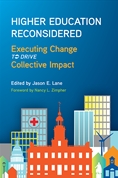
Higher Education Reconsidered: Executing Change to Drive Collective Impact
- Author
- Lane, Jason E., ed.
- Publisher
- SUNY Press, Albany, NY
- ISBN
- 9781438459523
- Table of Contents
-
List of Illustrations
Foreword: Bringing Collective Impact to Higher Education (Nancy L. Zimpher)
Acknowledgments
Introduction (Jason E. Lane)
ch. 1 Collective Leadership in Higher Education: Moving from Competition to Collaboration to Impact (Jason E. Lane, B. Alex Finsel, and Taya L. Owens)
ch. 2 The Inconvenient Truth about Change Management: Why It Isn’t Working and What to Do about It (Scott Keller and Carolyn Aiken)
ch. 3 From Perpetuation to Innovation: Breaking through Barriers to Change in Higher Education (Jonathan S. Gagliardi)
ch. 4 The Rise of Collective Impact (Jeff Edmondson and Nancy L. Zimpher)
ch. 5 Using Design Thinking to Drive Collective Impact in Higher Education (David J. Weerts, Christopher J. Rasmussen, and Virajita Singh)
ch. 6 The Albany Promise Story: How a Community Came Together to Go All-in on Education Reform (Juliette Price)
ch. 7 What Large-scale Change Looks Like and How to Get There: Theories of Action A conversation (Jeff Edmondson, Jason Helgerson, Danette Howard, James Kvaal, Becky Kanis Margiotta, and Joe McCannon Moderated by David Leonhardt)
Contributors
Index
Here for Book Review
Abstract: Focuses on the opportunities and challenges of using the science of change to improve the academic enterprise.
This is not another book about why higher education needs to change. This volume is about how to facilitate change. What could higher education achieve if varied stakeholders decided to work together to accomplish a shared vision by using data and scaling up evidence-based interventions? The contributors offer examples and instructions to help execute change in order to drive collective impact. When we understand large-scale change in other sectors, such as healthcare, business, and the social sector, it can help inform us of what collective impact looks like and how to get there. A deeper investigation into the science of change will enable us to work towards increasing access, overcoming racial disparities, reducing the need for remediation, and improving learning outcomes. (From the Publisher)
Abstract: Focuses on the opportunities and challenges of using the science of change to improve the academic enterprise.
This is not another book about why higher education needs to change. This volume is about how to facilitate change. What could higher education achieve if varied stakeholders decided to work together to accomplish a shared vision by using data and scaling up evidence-based interventions? The contributors offer examples and instructions to help execute change in order to drive collective impact. When we understand large-scale change in other sectors, such as healthcare, business, and the social sector, it can help inform us of what collective impact looks like and how to get there. A deeper investigation into the science of change will enable us to work towards increasing access, overcoming racial disparities, reducing the need for remediation, and improving learning outcomes. (From the Publisher)