Home » Resources » Scholarship on Teaching » Higher Education and the Color Line: College Access, Racial Equity, and Social Change
Scholarship
March 29, 2017
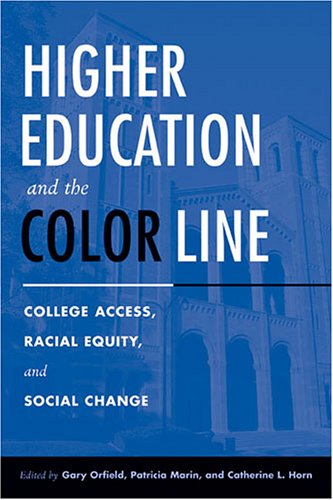
Higher Education and the Color Line: College Access, Racial Equity, and Social Change
- Author
- Orfield, Gary, Patricia Marin, and Catherine L. Horn, eds.
- Publisher
- Harvard Education Press, Cambridge, MA
- ISBN
- 1891792598
- Table of Contents
-
Acknowledgments
Introduction (Gary Orfield)
ch. 1 The racial transformation of higher education (Michal Kurlaender and Stella M. Flores)
ch. 2 Necessary but not sufficient : higher education as a strategy of social mobility (David Karen and Kevin J. Dougherty)
ch. 3 Equity in educational attainment : racial, ethnic, and gender inequality in the 50 states (Derek V. Price and Jill K. Wohlford)
ch. 4 Can minority students afford college in an era of skyrocketing tuition? (Donald E. Heller)
ch. 5 Illusions of opportunity? : from college access to job access at two-year colleges (Regina Deil Amen, James E. Rosenbaum, and Ann E. Person)
ch. 6 Diversity on campus : exemplary programs for retaining and supporting students of color (Dean K. Whitla, Carolyn Howard, Frank Tuitt, Richard J. Reddick, and Elizabeth Flanagan)
ch. 7 Potential or peril : the evolving relationship between large-scale standardized assessment and higher education (Catherine L. Horn)
ch. 8 After Grutter and Gratz : higher education, race, and the law (Angelo N. Ancheta)
ch. 9 From strict scrutiny to educational scrutiny : a new vision for higher education policy and research (Patricia Marin and John T. Yun)
About the Contributors
Index
This timely and comprehensive book outlines the agenda for achieving racial justice in higher education in the next generation. It focuses on the racial transformation of higher education and the structural barriers that perpetuate racial stratification in colleges and universities--and beyond. Taking on topical issues such as shifting patterns of financial aid, the growing importance of community colleges, and identifying model programs for retaining and supporting minority students, it lays the foundation for realizing the U.S. Supreme Court Justice Sandra Day O'Connor's goal of eliminating the need for affirmative action within 25 years. (From the Publisher)