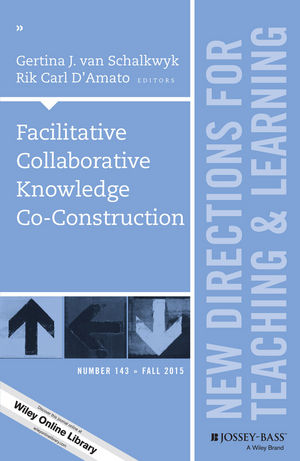
- Author
- van Schalkwyk, Gertina J.; and D'Amato, Rich Carl, eds.
- Publisher
- John Wiley & Sons, San Francisco (New Directions for Teaching and Learning, Number 143)
- ISBN
- 9781119169499
- Table of Contents
-
Prologue (Gertina J. van Schalkwyk, Rik Carl D’Amato)
ch. 1 Knowledge Construction: A Paradigm Shift (Hugh Gash)
This chapter explores the move toward a constructivist paradigm and collaborative knowledge construction in the broader institutional context of education.
ch. 2 Relational Intelligence and Collaborative Learning (Sheila McNamee, Murilo Moscheta)
This chapter explores the ways in which a relational understanding of the educational process might inform and transform university teaching.
ch. 3 Using a Brain-Based Approach to Collaborative Teaching and Learning with Asians (Rik Carl D’Amato, Yuan Yuan Wang)
This chapter advocates for a more contemporary ecological neuropsychology approach, where brain-learner-environmental interactions are the focus of study, assessment, and evidence-based intervention.
ch. 4 Emotional Intelligence and Sociocognitive Skills in Collaborative Teaching and Learning (Helen Y. Sung)
This chapter explores emotional intelligence as the glue that binds people together regardless of cultural differences.
ch. 5 Reading and Writing for Critical Reflective Thinking (Mary M. Chittooran)
This chapter examines the use of reading and writing activities to promote critical reflection among Asian students in higher education settings.
Index
Click Here for Book Review
Abstract: Collaborative teaching and learning has been a focus of research recently, yet it can sometimes be a challenge for multicultural students in an educational setting. This second volume of a two-volume edition helps lecturers, educators, and teachers create collaborative teaching and learning experiences with multicultural adult learners in higher education.
The authors of this volume provide:
- outlines of some of the positive relationships that can be developed among students and educators when the process of gaining knowledge is seen as a co-constructed process,
- approaches to relational intelligence and collaborative learning,
- research from neuropsychology and practical applications to teaching, and
- characterizations of emotional intelligence and sociocognitive skills needed in collaborative learning environments.
Though focused on Asian students and their experiences, this volume includes information for all students and educators who are engaged in the collaborative search for knowledge.
This is the 143rd volume of this Jossey-Bass higher education series. It offers a comprehensive range of ideas and techniques for improving college teaching based on the experience of seasoned instructors and the latest findings of educational and psychological researchers. (From the Publisher)
Abstract: Collaborative teaching and learning has been a focus of research recently, yet it can sometimes be a challenge for multicultural students in an educational setting. This second volume of a two-volume edition helps lecturers, educators, and teachers create collaborative teaching and learning experiences with multicultural adult learners in higher education.
The authors of this volume provide:
- outlines of some of the positive relationships that can be developed among students and educators when the process of gaining knowledge is seen as a co-constructed process,
- approaches to relational intelligence and collaborative learning,
- research from neuropsychology and practical applications to teaching, and
- characterizations of emotional intelligence and sociocognitive skills needed in collaborative learning environments.
Though focused on Asian students and their experiences, this volume includes information for all students and educators who are engaged in the collaborative search for knowledge.
This is the 143rd volume of this Jossey-Bass higher education series. It offers a comprehensive range of ideas and techniques for improving college teaching based on the experience of seasoned instructors and the latest findings of educational and psychological researchers. (From the Publisher)