Home » Resources » Scholarship on Teaching » Facilitating Intergroup Dialogues: Bridging Differences, Catalyzing Change
Scholarship
March 29, 2017
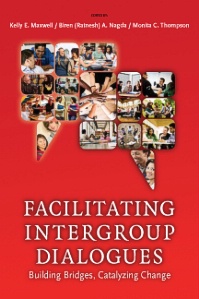
Facilitating Intergroup Dialogues: Bridging Differences, Catalyzing Change
- Author
- Maxwell, Kelly E., Ngad, Biren (Ratnesh), and Thompson, Monita C.
- Publisher
- Stylus Publishing, LLC, Sterling, VA
- ISBN
- 9781579222901
- Book Review Link
- http://onlinelibrary.wiley.com/doi/10.1111/teth.12104/abstract
- Table of Contents
-
Foreword
ch. 1 Deepening the Layers of Understanding and Connection: A Critical-Dialogic Approach to Facilitating Intergroup Dialogues
ch. 2 In the Hands of Facilitators - Student Experiences in Dialogue and Implications for Facilitator Training
Section One: Intergroup Dialogue Facilitation:Training for Classroom-based Experiences
ch. 3 Training Peer Facilitators as Social Justice Educators: Integrating Cognitive and Affective Learning
ch. 4 Facilitator Training in Diverse, Progressive Residential Communities: Occidental College as a Case Study
ch. 5 Preparing Critically Reflective Intergroup Dialogue Facilitators: A Pedagogical Model and Illustrative Example
ch. 6 (Re)Training Ourselves: Professionals Who Facilitate Intergroup Dialogue
Section Two: Intergroup Dialogue Facilitation Training for Applications to Campus and Community Settings
ch. 7 Training Students to Change Their Own Campus Culture Through Sustained Dialogue
ch. 8 Democracy Lab: Online Facilitation Training for Dialogic Teaching and Learning
ch. 9 Intergroup Dialogue Facilitation for Youth Empowerment and Community Change
ch. 10 Extending Intergroup Dialogue Facilitation to Multicultural Social Work Practice
Section Three: Learning From and With Intergroup Dialogue Facilitators: Voices on Identity, Alliances, and Career Commitments
ch. 11 Identity Matters: Facilitators’ Struggles and Empowered Use of Social Identities in Intergroup Dialogue
ch. 12 Not FOR Others, But WITH Others, For ALL of Us: Weaving Relationships, Co-Creating Spaces of Justice
ch. 13 Changing Facilitators, Facilitating Change:The Lives of Intergroup Dialogue Facilitators Post-College
Contributor Biographies
Index
Intergroup dialogue has emerged as an effective educational and community building method to bring together members of diverse social and cultural groups to engage in learning together so that they may work collectively and individually to promote greater diversity, equality and justice.
Intergroup dialogues bring together individuals from different identity groups (such as people of color and white people; women and men; lesbian, gay, and bisexual people and heterosexual people), and uses explicit pedagogy that involves three important features: content learning, structured interaction, and facilitative guidance.
The least understood role in the pedagogy is that of facilitation. This volume, the first dedicated entirely to intergroup dialogue facilitation, draws on the experiences of contributors and on emerging research to address the multi-dimensional role of facilitators and co-facilitators, the training and support of facilitators, and ways of improving practice in both educational and community settings. It constitutes a comprehensive guide for practitioners, covering the theoretical, conceptual, and practical knowledge they need.
Presenting the work and insights of scholars, practitioners and scholar-practitioners who train facilitators for intergroup dialogues, this book bridges the theoretical and conceptual foundations of intergroup relations and social justice education with training models for intergroup dialogue facilitation.
It is intended for staff, faculty, and administrators in higher education, and community agencies, as well as for human resources departments in workplaces. (From the Publisher)
Intergroup dialogues bring together individuals from different identity groups (such as people of color and white people; women and men; lesbian, gay, and bisexual people and heterosexual people), and uses explicit pedagogy that involves three important features: content learning, structured interaction, and facilitative guidance.
The least understood role in the pedagogy is that of facilitation. This volume, the first dedicated entirely to intergroup dialogue facilitation, draws on the experiences of contributors and on emerging research to address the multi-dimensional role of facilitators and co-facilitators, the training and support of facilitators, and ways of improving practice in both educational and community settings. It constitutes a comprehensive guide for practitioners, covering the theoretical, conceptual, and practical knowledge they need.
Presenting the work and insights of scholars, practitioners and scholar-practitioners who train facilitators for intergroup dialogues, this book bridges the theoretical and conceptual foundations of intergroup relations and social justice education with training models for intergroup dialogue facilitation.
It is intended for staff, faculty, and administrators in higher education, and community agencies, as well as for human resources departments in workplaces. (From the Publisher)