Home » Resources » Scholarship on Teaching » eService-Learning: Creating Experiential Learning and Civic Engagement Through Online and Hybrid Courses
Scholarship
March 29, 2017
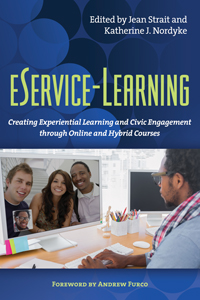
eService-Learning: Creating Experiential Learning and Civic Engagement Through Online and Hybrid Courses
- Author
- Strait, Jean R.; and Nordyke, Katherine, eds.
- Publisher
- Stylus, Sterling, VA
- ISBN
- 9781620360644
- Table of Contents
-
Foreward (Andrew Furco)
Acknowledgements (Katherine Nordyke and Jean Strait)
Introduction (Katherine Nordyke)
Part I: Essentials/Components / Nuts and Bolts of eService-Learning
ch. 1 Pedagogy of Civic Engagement, High Impact Practices, and eService-learning (Jean Strait, Jane Turk and Katherine Nordyke)
ch. 2 eService-Learning: Breaking Through the Barrier (Leora Waldner)
ch. 3 Developing an eService-learning Course (Katherine Nordyke)
ch. 4 Supporting eService-Learning Through Technology (Jean Strait)
Part II: Models of eService-Learning
ch. 5 Hybrid I: Missouri State University Embraces eService-learning (Katherine Nordyke)
ch. 6 Hybrid II: A Model Design for Web Development (Pauline Mosley)
ch. 7 Hybrid III: Each One Teach One Lessons from the Storm (Jean Strait)
ch. 8 Hybrid IV: Extreme eService-learning: Online Service-Learning in an Online Course (Sue McGorry)
ch. 9 Mixed Hybrid: Investigating the Influence of Online Components on Service-Learning Outcomes at the University of Georgia Hybrid I and III E-Service-Learning (Paul Matthews)
Part III: Next Steps and Future Directions
ch. 10 Community Engagement and Technology for a More Relevant Higher Education (John Hamerlinck)
ch. 11 Conclusions and Future Directions (Jean Strait)
Editors and Contributors
Index
Click Here for Book Review
Abstract: This book serves as an introduction to using online teaching technologies and hybrid forms of teaching for experiential learning and civic engagement. Service-learning has kept pace neither with the rapid growth in e-learning in all its forms nor with the reality that an increasing number of students are learning online without exposure to the benefits of this powerful pedagogy.
Eservice-learning (electronic service-learning) combines service-learning and on-line learning and enables the delivery of the instruction and/or the service to occur partially or fully online. Eservice-learning allows students anywhere, regardless of geography, physical constraints, work schedule, or other access limitations, to experience service-learning. It reciprocally also equips online learning with a powerful tool for engaging students.
In eservice-learning, the core components of service, learning, and reflection may take a different form due to the online medium—for example, reflection often occurs through discussion board interactions, journals, wikis, or blogs in an eservice-learning course. Moreover, the service, though still community-based, creates a world of opportunities to connect students with communities across the globe—as well as at their very own doorstep.
This book introduces the reader to the four emerging types of eservice-learning, from Extreme EService-Learning (XE-SL) classes where 100% of the instruction and 100% of the service occur online, to three distinct forms of hybrid where either the service or the instruction are delivered wholly on-line – with students, for instance, providing online products for far-away community partners – or in which both are delivered on-site and online. It considers the instructional potential of common mobile technologies – phones, tablets and mobile reading devices. The authors also address potential limitations, such as technology challenges, difficulties sustaining three-way communication among the instructor, community partner, and students, and added workload.
The book includes research studies on effectiveness as well as examples of practice such drafting grants for a community partner, an informational technology class building online communities for an autism group, and an online education class providing virtual mentoring to at-risk students in New Orleans from across the country. (From the Publisher)
Abstract: This book serves as an introduction to using online teaching technologies and hybrid forms of teaching for experiential learning and civic engagement. Service-learning has kept pace neither with the rapid growth in e-learning in all its forms nor with the reality that an increasing number of students are learning online without exposure to the benefits of this powerful pedagogy.
Eservice-learning (electronic service-learning) combines service-learning and on-line learning and enables the delivery of the instruction and/or the service to occur partially or fully online. Eservice-learning allows students anywhere, regardless of geography, physical constraints, work schedule, or other access limitations, to experience service-learning. It reciprocally also equips online learning with a powerful tool for engaging students.
In eservice-learning, the core components of service, learning, and reflection may take a different form due to the online medium—for example, reflection often occurs through discussion board interactions, journals, wikis, or blogs in an eservice-learning course. Moreover, the service, though still community-based, creates a world of opportunities to connect students with communities across the globe—as well as at their very own doorstep.
This book introduces the reader to the four emerging types of eservice-learning, from Extreme EService-Learning (XE-SL) classes where 100% of the instruction and 100% of the service occur online, to three distinct forms of hybrid where either the service or the instruction are delivered wholly on-line – with students, for instance, providing online products for far-away community partners – or in which both are delivered on-site and online. It considers the instructional potential of common mobile technologies – phones, tablets and mobile reading devices. The authors also address potential limitations, such as technology challenges, difficulties sustaining three-way communication among the instructor, community partner, and students, and added workload.
The book includes research studies on effectiveness as well as examples of practice such drafting grants for a community partner, an informational technology class building online communities for an autism group, and an online education class providing virtual mentoring to at-risk students in New Orleans from across the country. (From the Publisher)