Home » Resources » Scholarship on Teaching » Ensuring the Success of Latino Males in Higher Education: A National Imperative
Scholarship
March 29, 2017
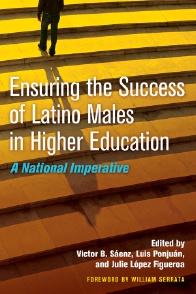
Ensuring the Success of Latino Males in Higher Education: A National Imperative
- Author
- Saenz, Victor B.; Ponjuan, Luis; and Figueroa, Julia, eds.
- Publisher
- Stylus, Sterling, VA
- ISBN
- 9781579227883
- Table of Contents
-
Foreword (William Serrata)
Preface (Victor B. S√°enz)
Acknowledgments
Part One: Introduction and Context-Setting: Latino Males in K–12 and Higher Education
ch. 1 Current Trends and Future Outlooks on the Pervasive Gender Gap in Educational Attainment for Latino Males (Victor B. Sáenz, Luis Ponjuán, and Julie López Figueroa)
ch. 2 Latino Males in American High Schools: An Examination of the 2012 High School Longitudinal Study (Luis Ponju√°n)
Part Two: Exploring Theories to Understand the Pathways for Latino Males in Higher Education
ch. 3 The Geography of Academic Support: A Framework to Understand the Latino Male Perceptions and Practices in Higher Education (Julie López Figueroa)
ch. 4 (Re)Constructing Masculinity: Understanding Gender Expectations Among Latino Male College-Going Students (Julie López Figueroa, Patricia Pérez, and Irene I. Vega)
ch. 5 An Intersectionality Analysis of Latino Men in Higher Education and Their Help-Seeking Behaviors (Nolan L. Cabrera, Fatemma D. Rashwan-Soto, and Bryant G. Valencia)
Part Three: Research on Preparation, Persistence, and Success for Latino Males in Secondary and Postsecondary Education
ch. 6 Latino Male High School Math Achievement: The Influential Role of Psychosociocultural Factors (Ismael Fajardo, José M. Hernandez, and José Muñoz)
ch. 7 Examining the Role of Family in Mexican American College Men’s Academic Persistence (Lizette Ojeda and Linda G. Castillo)
ch. 8 Over the Ivy Wall: Latino Male Achievers Nurturing Cultural Wealth at a Highly Selective Predominantly White Research University (David Pérez II)
ch. 9 Caballeros Making Capital Gains in College: The Role of Social Capital in First-Year Persistence at a Predominantly White 4-Year Institution (Tracy L. Ar√°mbula)
Part Four: Moving From Research to Practice: Meeting the Needs of Latino Males in Higher Education
ch. 10 Latino Males In Higher Education: Administrator Awareness of the Emerging Challenges (Victor B. S√°enz, Sarah Rodriguez, Katie Ortego Pritchett,Jennifer Estrada, and Kelty Garbee)
ch. 11 Educational Opportunity, College Choices, and Higher Education: What Can We Learn From Research on Latinas? (Miguel A. Ceja)
ch. 12 Collaborative Consciousness: Improving Latino Male Student Research, Policy, and Practice (Luis Ponju√°n)
Editors and Contributors
Index
Click Here for Book Review
Latino males are effectively vanishing from the American higher education pipeline. Even as the number of Latinas/os attending college has actually increased steadily over the last few decades, the proportional representation of Latino males continues to slide relative to their Latina female counterparts.
The question of why Latino males are losing ground in accessing higher education—relative to their peers—is an important and complex one, and it lies at the heart of this book. There are several broad themes highlighted, catalogued along with the four dimensions of policy, theory, research, and practice. The contributors to this book present new research on factors that inhibit or promote Latino success in both four-year institutions and community colleges in order to inform both policy and practice. They explore the social-cultural factors, peer dynamics, and labor force demands that may be perpetuating the growing gender gap, and consider what lessons can be learned from research on the success of Latinas. This book also closely examines key practices that enable first generation Latino male undergraduates to succeed which may seem counterintuitive to institutional expectations and preconceived notions of student behavior.
Using narrative data, the book also explores the role of family in persistence; outlines how Latino men conceptualize fulfilling expectations, negotiate the emasculization of the educational process, and how they confront racialization in the pursuit of a higher education; uncovers attitudes to help-seeking that are detrimental to their success: and analyzes how those who succeed and progress in college apply their social capital – whether aspirational, navigational, social, linguistic, familial, or resistant.
While uncovering the lack of awareness at all levels of our colleges and universities about the depth and severity of the challenges facing Latino males, this book provides the foundation for rethinking policy; challenges leaders to institutionalize male-focused programs and services; and presents data to inform needed changes in practice for outreach and retention. (From the Publisher)
Latino males are effectively vanishing from the American higher education pipeline. Even as the number of Latinas/os attending college has actually increased steadily over the last few decades, the proportional representation of Latino males continues to slide relative to their Latina female counterparts.
The question of why Latino males are losing ground in accessing higher education—relative to their peers—is an important and complex one, and it lies at the heart of this book. There are several broad themes highlighted, catalogued along with the four dimensions of policy, theory, research, and practice. The contributors to this book present new research on factors that inhibit or promote Latino success in both four-year institutions and community colleges in order to inform both policy and practice. They explore the social-cultural factors, peer dynamics, and labor force demands that may be perpetuating the growing gender gap, and consider what lessons can be learned from research on the success of Latinas. This book also closely examines key practices that enable first generation Latino male undergraduates to succeed which may seem counterintuitive to institutional expectations and preconceived notions of student behavior.
Using narrative data, the book also explores the role of family in persistence; outlines how Latino men conceptualize fulfilling expectations, negotiate the emasculization of the educational process, and how they confront racialization in the pursuit of a higher education; uncovers attitudes to help-seeking that are detrimental to their success: and analyzes how those who succeed and progress in college apply their social capital – whether aspirational, navigational, social, linguistic, familial, or resistant.
While uncovering the lack of awareness at all levels of our colleges and universities about the depth and severity of the challenges facing Latino males, this book provides the foundation for rethinking policy; challenges leaders to institutionalize male-focused programs and services; and presents data to inform needed changes in practice for outreach and retention. (From the Publisher)