Home » Resources » Scholarship on Teaching » Encountering Faith in the Classroom: Turning Difficult Discussions into Constructive Engagement
Scholarship
March 29, 2017
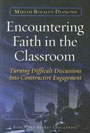
Encountering Faith in the Classroom: Turning Difficult Discussions into Constructive Engagement
- Author
- Diamond, Miriam Rosalyn, ed.
- Publisher
- Stylus Publishing, LLC, Sterling, VA
- ISBN
- 9781579222376
- Table of Contents
-
Foreword (Art Chickering)
Introduction - Faith in Learning: An Overview (Miriam Rosalyn Diamond, and Christina Copre)
Pt. 1 Society, Learning, and Religion
ch. 1 Faith and Reason
Higher Education's Opportunities and Challenges (Nancy L. Thomas, and Ann Marie B. Bahr)
Appendix Wingspread Declaration on Religion and Public Life
Pt. 2 Student and Faculty Perspectives
ch. 2 Undergraduate Perspectives About Religion in Higher Education (Lois Calian Trautvetter)
ch. 3 Faith in Graduate Education
Perspectives of Students and Faculty in Student Affairs Preparation Programs (Judy L. Rogers, and Patrick G. Love)
Pt. 3 Considerations
ch. 4 Blinking in the Sunlight
Exploring the Fundamentalist Perspective (Peggy Catron)
ch. 5 What I Think I Believe
Using the Change Method to Resolve Cognitive Dissonance (Tamara H. Rosier)
ch. 6 Bringing Faith and Spirituality Into the Classroom
An African American Perspective (Mark S. Giles , Odelet Nance, and Noelle Witherspoon)
ch. 7 Religion in the Classroom
Legal Issues (Barbara A. Lee)
Pt. 4 Disciplinary Approaches
ch. 8 Exploring Religion and Spirituality Through Academic Service Learning (Kent Koth)
ch. 9 Philosophy and Religious Disagreements in the College Classroom (Dona Warren)
ch. 10 When Faith and Science Collide (Mana Singham)
ch. 11 Teaching Secular Bible Reading to Religiously Committed Students (Roger G. Baker)
ch. 12 The Role of Religion and Spirituality in theLaw School Classroom (David Hall)
ch. 13 Teaching About Religious and Spiritual Pluralism in a Professional Education Course (Robert J. Nash, and Sue M. Baskette)
Afterword (Miriam Rosalyn Diamond)
About the Authors
Index
When faculty unexpectedly encounter students' religious ideologies in the classroom, they may respond with apprehension, frustration, dread, or concern. Instructors may view this exchange as a confrontation that threatens the very heart of empirical study, and worry that this will lead to a dead-end in the learning process.
The purpose of this book is to explore what happens—and what can happen—in the higher education, and even secondary school, classroom when course content meets or collides with students' religious beliefs. It also considers the impact on learning in an environment where students may feel threatened, angry, misunderstood, or in which they feel their convictions are being discredited.
This is a resource that offers ways of conceptualizing, engaging with, and responding to, student beliefs. This book is divided into three sections: student views on the role of religion in the classroom; general guidelines for responding to or actively engaging religious beliefs in courses (such as legal and diversity considerations); and specific examples from a number of disciplines (including the sciences, social sciences, humanities and professional education). Professors from public, private, and religious institutions share their findings and insights.
The resounding lessons of this book are the importance of creating a learning space in which students can express their beliefs, dissonance, and emotions constructively, without fear of retribution; and of establishing ground rules of respectful discussion for this process to be valuable and productive.
This is an inspirational and practical guide for faculty navigating thecontroversial, sensitive—yet illuminating—lessons that can be learned when religion takes a seat in the classroom. (From the Publisher)
The purpose of this book is to explore what happens—and what can happen—in the higher education, and even secondary school, classroom when course content meets or collides with students' religious beliefs. It also considers the impact on learning in an environment where students may feel threatened, angry, misunderstood, or in which they feel their convictions are being discredited.
This is a resource that offers ways of conceptualizing, engaging with, and responding to, student beliefs. This book is divided into three sections: student views on the role of religion in the classroom; general guidelines for responding to or actively engaging religious beliefs in courses (such as legal and diversity considerations); and specific examples from a number of disciplines (including the sciences, social sciences, humanities and professional education). Professors from public, private, and religious institutions share their findings and insights.
The resounding lessons of this book are the importance of creating a learning space in which students can express their beliefs, dissonance, and emotions constructively, without fear of retribution; and of establishing ground rules of respectful discussion for this process to be valuable and productive.
This is an inspirational and practical guide for faculty navigating thecontroversial, sensitive—yet illuminating—lessons that can be learned when religion takes a seat in the classroom. (From the Publisher)