Home » Resources » Scholarship on Teaching » Empowering Women in Higher Education and Student Affairs: Theory, Research, Narratives, and Practice From Feminist Perspectives
Scholarship
March 29, 2017
Empowering Women in Higher Education and Student Affairs: Theory, Research, Narratives, and Practice From Feminist Perspectives
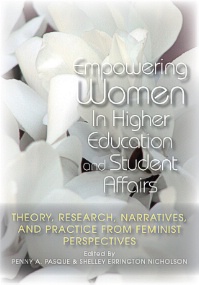
- Author
- Pasque, Penny A., and Nicholson, Shelley Errington, eds.
- Publisher
- Stylus Publishing, LLC, Sterling, VA
- ISBN
- 9781579223502
- Book Review Link
- http://onlinelibrary.wiley.com/doi/10.1111/teth.12097/abstract
- Table of Contents
-
Foreword
Preface
Section I: Setting the Context: A Contemporary (Re)Examination of Women in Higher Education and Student Affairs
ch. 1 An Introduction to Feminism and Feminist Perspectives in Higher Education (Shelley Errington Nicholson and Penny A. Pasque)
ch. 2 Reflections From "Professional Feminists" in Higher Education (Susan Marine)
ch. 3 "Each Generation of Women had to Start Anew" (Jennifer LeeHoffman)
ch. 4 The Powerful Collaborations Between Deans of Women and Directors of Physical Education (Thalia Mulvihill)
Section II: Considering Experiences of Women throughout the Academy: An Exploration of Undergraduates, Graduate Students and Administrators
ch. 5 Female Graduate Students Work-Life Balance and the Student Affairs Professional (Rachael L. Simpson and Kim L. Filer)
ch. 6 High Achieving Women (Monica Marcelis Fochtman)
ch. 7 Toward Self-Investment (Annemarie Vaccaro)
ch. 8 The Influence of Gender (Jennifer Sader)
Section III: Exploring Identity Contexts: The Intersections of Class, Gender, Race, and Sexual Orientation for Faculty, Administrators, and Students
ch. 9 How Race Matters: Race as an Instrument for Institutional Transformations, a Study of Tenured Black Female Faculty (Venice Thandi Sule)
ch. 10 Life Stories From the Daughter of First-Generation Italian Immigrants: Gender, Ethnicity, Culture, and Class Intertwine to Form an Italian American Feminist (Florence Guido DiBrito)
ch. 11 Economically Disadvantaged Women in Higher Education: Hearing Their Stories and Striving for Social Justice (Penny J. Rice)
ch. 12 Sister Circles: A Dialogue on the Intersections of Gender, Race, and Student Affairs (Mariama Boney; Linda Contreras Bullock; Cie Cochran; Irene Kao; and Amanda Suniti Niskode-Dossett)
ch. 13 Using Queer Theory to Explore Lesbian College Students’ Multiple Dimensions of Identity (Elisa Abes, and David Kasch)
ch. 14 Identity Development in College Women (Amy Stalzer Sengupta and Yvette Loury Upton)
Section IV: Advancing the Future: Strategies for Changing Dominant Paradigms
ch. 15 The Campus Women’s Center as Classroom: A Model for Thinking and Action (Jennifer R. Wies )
ch. 16 In (Re)Search of Women in Student Affairs Administration (Tamara Yakaboski and Saran Donahoo)
ch. 17 Campus-Based Sexual Assault Prevention: Perspectives and Recommendations From Program Facilitators (Lindsay M. Orchowski, Eric Zimak, Troy Robison, Justin Reeder, Ryan Rhoades, Christine A. Gidycz and Alan Berkowitz )
ch. 18 Learning and Leading Together: A Cohort-Based Model for Women’s Advancement (Lee S. Hawthorne Calizo)
Section V: Envisioning and Acting on a Feminist Future
ch. 19 Envisioning A New Future With Feminist Voices (Amanda Suniti Niskode-Dossett, Shelley Errington Nicholson, and Penny A. Pasque)
About the Contributors
Index
How do we interrupt the current paradigms of sexism in the academy? How do we construct a new and inclusive gender paradigm that resists the dominant values of the patriarchy? And why are these agendas important not just for women, but for higher education as a whole?
These are the questions that these extensive and rich analyses of the historical and contemporary roles of women in higher education— as administrators, faculty, students, and student affairs professionals—seek constructively to answer. In doing so they address the intersection of gender and women’s other social identities, such as of race, ethnicity, sexual orientation, class, and ability.
This book addresses the experiences and position of women students, from application to college through graduate school, and the barriers they encounter; the continuing inequalities in the rates of promotion and progression of women and other marginalized groups to positions of authority, and the gap in earnings between men and women; and pays particular attention to how race and other social markers impact such disparities, contextualizing them across all institutional types.
Written collaboratively by an intergenerational group of women, men, and transgender people with different social identities, feminist perspectives, and professional identities— and who, in the process, built upon each other’s work—this volume constitutes a call to educators and scholars to work toward centering feminist and other marginalized perspectives in their practice and research in order to equitably address the evolving complexities of college and university life. Employing a wide range of theoretical lenses, examining a variety of models of practice, and giving voice to a diversity of personal experiences through narrative, this is a major contribution to the scholarship on women in higher education.
This is a book for all women in the academy who want to better understand their experience, and to dismantle the remaining barriers of sexism and oppression—for themselves, and future generations of students. (From the Publisher)
These are the questions that these extensive and rich analyses of the historical and contemporary roles of women in higher education— as administrators, faculty, students, and student affairs professionals—seek constructively to answer. In doing so they address the intersection of gender and women’s other social identities, such as of race, ethnicity, sexual orientation, class, and ability.
This book addresses the experiences and position of women students, from application to college through graduate school, and the barriers they encounter; the continuing inequalities in the rates of promotion and progression of women and other marginalized groups to positions of authority, and the gap in earnings between men and women; and pays particular attention to how race and other social markers impact such disparities, contextualizing them across all institutional types.
Written collaboratively by an intergenerational group of women, men, and transgender people with different social identities, feminist perspectives, and professional identities— and who, in the process, built upon each other’s work—this volume constitutes a call to educators and scholars to work toward centering feminist and other marginalized perspectives in their practice and research in order to equitably address the evolving complexities of college and university life. Employing a wide range of theoretical lenses, examining a variety of models of practice, and giving voice to a diversity of personal experiences through narrative, this is a major contribution to the scholarship on women in higher education.
This is a book for all women in the academy who want to better understand their experience, and to dismantle the remaining barriers of sexism and oppression—for themselves, and future generations of students. (From the Publisher)