- Author
- Finkel, Donald L.
- Publisher
- Rutgers University Press, New Brunswick, NJ
- ISBN
- 813522013
- Table of Contents
-
Acknowledgments
Introduction
ch. 1 The Promise of a Personal Pedagogy: Rousseau's Emile
ch. 2 The Paradox of a Personal Pedagogy: Freud's Concept of Transference
ch. 3 The Promise of a Social Pedagogy: Paulo Freire's Culture Circles
ch. 4 The Paradox of a Social Pedagogy: The Institutional Analyses of Ivan Illich and Michel Foucault
ch. 5 Turning Away from the Student-Teacher Relationship / Turning Toward Colleagues
ch. 6 Collegial Teaching
Conclusion
Notes
Index
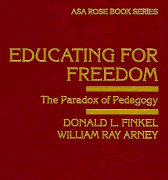
The very notion of teaching freedom suggests a paradox. Ever since Rousseau, the project of liberal education has been situated in the matrix of the teacher-student relationship. Some theorists have even seen this relationship as erotic. Part one of this book explores the educational philosophies of Rousseau, Freud, Paolo Freire, Ivan Illich, and Michel Foucault. All these thinkers wrestle with the paradox, How can such a mutually dependent relationship foster independence? The primary vehicle necessary to a liberating education, the personal relationship, is also the fundamental obstacle to the achievement of genuine liberation.
After reaching this conclusion, the authors turn away from the student-teacher relationship and the paradox of pedagogy to examine another type of teaching and learning--where two teachers who differ in fundamental ways engage in collegial teaching with students they have in common. Collegial teaching is described in its particularity, based on the authors' experiences at an unusual liberal arts college, The Evergreen State College. They find that the changed dynamics of equality and the altered structure of authority created by collegial teaching is rewarding for both teachers and students, and may be a way out of the paradox of pedagogy to intellectual freedom. (From the Publisher)
After reaching this conclusion, the authors turn away from the student-teacher relationship and the paradox of pedagogy to examine another type of teaching and learning--where two teachers who differ in fundamental ways engage in collegial teaching with students they have in common. Collegial teaching is described in its particularity, based on the authors' experiences at an unusual liberal arts college, The Evergreen State College. They find that the changed dynamics of equality and the altered structure of authority created by collegial teaching is rewarding for both teachers and students, and may be a way out of the paradox of pedagogy to intellectual freedom. (From the Publisher)