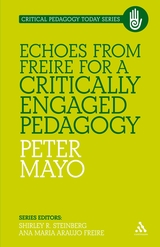
- Author
- Mayo, Peter
- Publisher
- Bloomsbury Academic, New York, NY
- ISBN
- 9781441110855
- Table of Contents
-
Acknowledgements
Freirean Concepts
ch. 1 Introduction: Pedagogy of the Oppressed
ch. 2 Freire's Ideas More Generally: On Whose Side Are We When We Teach Act?
ch. 3 Freire on Intellectuals
Freirean Interpretations
ch. 4 Reading and Transforming the World Together: A Freirean Perspective on Education and Social Movements
ch. 5 The Competence Discourse and the Struggle for Social Agency and Citizenship: A Freirean Perspective
ch. 6 Critical Literacy and the Development of a Multi-Ethnic Citizenship: A Freirean Southern-European Perspective
ch. 7 Popular Education and Transformative Research
ch. 8 Adult Learning, Teaching and Programme Planning: Insights from Freire
Affinities With Freire
ch. 9 Paulo Freire and Lorenzo Milani
ch. 10 Julius Nyerere's Thinking on Education
Freirean Inspiration
ch. 11 Critical Pedagogy, Historical Materialism and Dialectical Thinking: A Tribute to Paula Allman
ch. 12 Dissidence, Love and Cultural Power: An Essay on Antonia Darder
ch. 13 Striving Against the Eclipse of Democracy: Henry A. Giroux's Critical Pedagogy for Social Justice
Bibliography
Author Index
Subject Index
Click Here for Book Review
Abstract: In this concise and accessible text, Peter Mayo outlines some of the major concepts in Freire's praxis. In pursuit of a critically engaging pedagogy, Mayo compares Freire's work with a range of other thinkers and educators, including Lorenzo Milani, Antonia Darder, John Dewey, Margaret Ledwith, Antonio Gramsci, and Henry Giroux.
Chapters in the book include discussions of the State's role in education - specifically higher education; a critical analysis of the dominant discourse in education centering on 'competences' and the type of slant this discourse takes; a study of adult education through a Freirean lens; an historical view of Nicaragua's Freire-inspired literacy and popular education campaigns of 1980; a fresh perspective on the role of social movements in the contexts of social transformation; a new analysis of the relevance of Freirean concepts for transformative research, and an exploration of educators as intellectuals and social actors.
The result is a compelling study of how Paulo Freire's writings continue to resonate around the world, and of how we must continue to apply and interpret them anew. (From the Publisher)
Abstract: In this concise and accessible text, Peter Mayo outlines some of the major concepts in Freire's praxis. In pursuit of a critically engaging pedagogy, Mayo compares Freire's work with a range of other thinkers and educators, including Lorenzo Milani, Antonia Darder, John Dewey, Margaret Ledwith, Antonio Gramsci, and Henry Giroux.
Chapters in the book include discussions of the State's role in education - specifically higher education; a critical analysis of the dominant discourse in education centering on 'competences' and the type of slant this discourse takes; a study of adult education through a Freirean lens; an historical view of Nicaragua's Freire-inspired literacy and popular education campaigns of 1980; a fresh perspective on the role of social movements in the contexts of social transformation; a new analysis of the relevance of Freirean concepts for transformative research, and an exploration of educators as intellectuals and social actors.
The result is a compelling study of how Paulo Freire's writings continue to resonate around the world, and of how we must continue to apply and interpret them anew. (From the Publisher)