Home » Resources » Scholarship on Teaching » Creating Engaging Discussions: Strategies for "Avoiding Crickets" in Any Size Classroom and Online
Scholarship
September 19, 2018
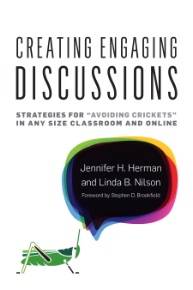
Creating Engaging Discussions: Strategies for “Avoiding Crickets” in Any Size Classroom and Online
- Author
- Herman, Jennifer H.; Nilson, Linda
- Publisher
- Stylus Publishing, Llc.
- ISBN
- 9781620365601
- Table of Contents
-
Foreword—Stephen D. Brookfield
Preface
Acknowledgements
Ch 1. The Strengths and Challenges of Discussion—Jennifer H. Herman and Linda B. Nilson
Ch 2. Getting All Students Engaged—Jennifer H. Herman and Linda B. Nilson
Ch 3. Preventing and Responding to Common Discussion Pitfalls—Jennifer H. Herman and Linda B. Nilson
Ch 4. Connecting Discussion With Learning—Jennifer H. Herman and Linda B. Nilson
Ch 5. Gauging the Effectiveness of a Discussion—Jennifer H. Herman and Linda B. Nilson
Ch 6. Learning and Interpreting History Through Deliberative Dialogue—Mary Jo Festle
Ch 7. How Coteaching and Other Strategies Promote Lively Student Engagement—Matthea Marquart and Mary Ann Drury
Ch 8. Got Introverts? Get CAE (Collaborative Autoethnography)—Mary Shapiro
Ch 9. Using a Contemplative Pedagogy to Promote Discussion in a First-Year Seminar—Jennifer W. Shewmaker
Ch 10. Avoiding Crickets by Creating an Orchestra of Students—Billy Strean
Ch 11. Spicing Up Students’ Education: The Use of Course-Based Undergraduate Research to Foster Student Communication—Heather Townsend
Ch 12. Applying Students’ Insights for Engaging Inquiry in a Blended Course—Janelle DeCarrico Voegele
Ch 13. Solve Several Online Course Challenges With Student Critiques of Primary Literature—David M. Wilson
Ch 14. Faculty Discussion Group Resources—Jennifer H. Herman and Linda B. Nilson
References
About the Authors and Contributors
Index
Click Here for Book Review
If you have ever been apprehensive about initiating classroom discussion, fearing silences, the domination of a couple of speakers, superficial contributions, or off-topic remarks, this book provides strategies for creating a positive learning experience.
Jennifer H. Herman and Linda B. Nilson demonstrate how to create the conditions to facilitate deep and meaningful learning as well as to assess the effectiveness of discussions. They identify, analyze, and solve common problems in both classroom and online discussions and in both small and large classes. They take a direct, practice-oriented approach that, in acknowledging common challenges, provides principles, guidance on design, examples of activities and techniques, and eight detailed case studies. These cases demonstrate successful approaches that faculty across disciplines and from a variety of institutions have adopted in their face-to-face, blended, or online courses at the undergraduate or graduate level.
The case authors begin by describing the original pedagogical challenge they faced and explain how they addressed it and assessed the results of their innovation. They also offer practical recommendations to readers who may want to try their strategies.
Intended for faculty, this book will be equally valuable for educational developers who can use this resource in their programs and private consultations. At the graduate level, this book can serve as a text or workshop resource in college teaching courses and teaching assistant development programs. The final chapter provides a set of resources and activities – including discussion questions on the case studies, writing prompts, and jigsaw formats – that are equally appropriate for individual study or for use in workshop environments.
You’ll never again have to suffer such a profound silence that, as described by a contributor to the book, she could hear the crickets chirping outside. (From the Publisher)
If you have ever been apprehensive about initiating classroom discussion, fearing silences, the domination of a couple of speakers, superficial contributions, or off-topic remarks, this book provides strategies for creating a positive learning experience.
Jennifer H. Herman and Linda B. Nilson demonstrate how to create the conditions to facilitate deep and meaningful learning as well as to assess the effectiveness of discussions. They identify, analyze, and solve common problems in both classroom and online discussions and in both small and large classes. They take a direct, practice-oriented approach that, in acknowledging common challenges, provides principles, guidance on design, examples of activities and techniques, and eight detailed case studies. These cases demonstrate successful approaches that faculty across disciplines and from a variety of institutions have adopted in their face-to-face, blended, or online courses at the undergraduate or graduate level.
The case authors begin by describing the original pedagogical challenge they faced and explain how they addressed it and assessed the results of their innovation. They also offer practical recommendations to readers who may want to try their strategies.
Intended for faculty, this book will be equally valuable for educational developers who can use this resource in their programs and private consultations. At the graduate level, this book can serve as a text or workshop resource in college teaching courses and teaching assistant development programs. The final chapter provides a set of resources and activities – including discussion questions on the case studies, writing prompts, and jigsaw formats – that are equally appropriate for individual study or for use in workshop environments.
You’ll never again have to suffer such a profound silence that, as described by a contributor to the book, she could hear the crickets chirping outside. (From the Publisher)