Home » Resources » Scholarship on Teaching » Contemplative Practices in Higher Education: Powerful Methods to Transform Teaching and Learning
Scholarship
March 29, 2017
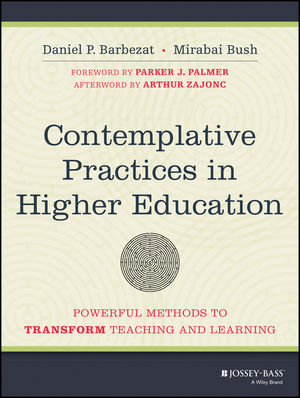
Contemplative Practices in Higher Education: Powerful Methods to Transform Teaching and Learning
- Author
- Barbezat, Daniel P.; and Bush, Mirabai
- Publisher
- Jossey-Bass, San Francisco, CA
- ISBN
- 9781118435274
- Table of Contents
-
Foreword by Parker J. Palmer
Preface
Acknowledgments
The Authors
Part One - Theoretical and Practical Background
ch. 1 Transformation and Renewal in Higher Education
ch. 2 Current Research on Contemplative Practice
ch. 3 Contemplative Pedagogy in Practice: Two Experiences
ch. 4 Teacher Preparation and Classroom Challenges
Part Two - A Guide to Contemplative Practices
Introduction to the Practices
ch. 5 Mindfulness
ch. 6 Contemplative Approaches to Reading and Writing
ch. 7 Contemplative Senses: Deep Listening and Beholding
ch. 8 Contemplative Movement
ch. 9 Compassion and Loving Kindness
ch. 10 Guest Speakers, Field Trips, and Retreats
ch. 11 Conclusion
Afterword by Arthur Zajonc
References
Index
Click Here for Book Review
Abstract: Contemplative pedagogy is a way for instructors to:
- empower students to integrate their own experience into the theoretical material they are being taught in order to deepen their understanding;
- help students to develop sophisticated problem-solving skills;
- support students’ sense of connection to and compassion for others; and
- engender inquiries into students’ most profound questions.
Contemplative practices are used in just about every discipline—from physics to economics to history—and are found in every type of institution. Each year more and more faculty, education reformers, and leaders of teaching and learning centers seek out best practices in contemplative teaching, and now can find them here, brought to you by two of the foremost leaders and innovators on the subject.
This book presents background information and ideas for the practical application of contemplative practices across the academic curriculum from the physical sciences to the humanities and arts. Examples of contemplative techniques included in the book are mindfulness, meditation, yoga, deep listening, contemplative reading and writing, and pilgrimage, including site visits and field trips. (From the Publisher)
Abstract: Contemplative pedagogy is a way for instructors to:
- empower students to integrate their own experience into the theoretical material they are being taught in order to deepen their understanding;
- help students to develop sophisticated problem-solving skills;
- support students’ sense of connection to and compassion for others; and
- engender inquiries into students’ most profound questions.
Contemplative practices are used in just about every discipline—from physics to economics to history—and are found in every type of institution. Each year more and more faculty, education reformers, and leaders of teaching and learning centers seek out best practices in contemplative teaching, and now can find them here, brought to you by two of the foremost leaders and innovators on the subject.
This book presents background information and ideas for the practical application of contemplative practices across the academic curriculum from the physical sciences to the humanities and arts. Examples of contemplative techniques included in the book are mindfulness, meditation, yoga, deep listening, contemplative reading and writing, and pilgrimage, including site visits and field trips. (From the Publisher)