Home » Resources » Scholarship on Teaching » Best Practices in Engaging Online Learners Through Active and Experiential Learning Strategies
Scholarship
September 26, 2019
Best Practices in Engaging Online Learners Through Active and Experiential Learning Strategies
- Author
- Budhai, Stephanie Smith, and Skipwith, Ke'Anna
- Publisher
- Routledge, Taylor & Francis Group
- ISBN
- 9781138670686
- Table of Contents
-
Ch 1. Engagement Beyond the Discussion Board
Ch 2. Experiential Learning (Cooperative Education Internships, Practicums, Service-learning, and Study Abroad)
Ch 3. Project and Scenario-based Learning
Ch 4. Gamification and Social Media
Ch 5. Building Social Presence through Participatory and Peer-Learning Opportunities
Ch 6. Assessment of Active and Experiential Learning
References
Index
Click Here for Book Review
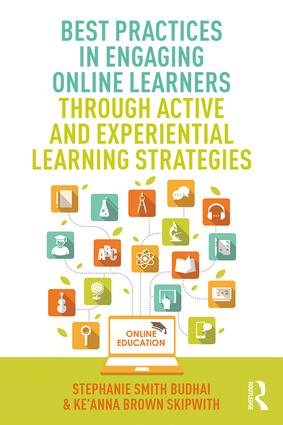
Best Practices in Engaging Online Learners Through Active and Experiential Learning Strategies is a practical guide for all instructors and instructional designers working in online or blended learning environments who want to provide a supportive, engaging, and interactive learner experience. This book explores the integration of active and experiential learning approaches and activities including gamification, social media integration, and project- and scenario-based learning, as they relate to the development of authentic skill-building, communication, problem-solving, and critical-thinking skills in learners. Readers will find guidelines for the development of participatory peer-learning, cooperative education, and service learning opportunities in the online classroom. In addition, the authors provide effective learning strategies, resources, and tools that align learner engagement with course outcomes. (From the Publisher)
Best Practices in Engaging Online Learners Through Active and Experiential Learning Strategies is a practical guide for all instructors and instructional designers working in online or blended learning environments who want to provide a supportive, engaging, and interactive learner experience. This book explores the integration of active and experiential learning approaches and activities including gamification, social media integration, and project- and scenario-based learning, as they relate to the development of authentic skill-building, communication, problem-solving, and critical-thinking skills in learners. Readers will find guidelines for the development of participatory peer-learning, cooperative education, and service learning opportunities in the online classroom. In addition, the authors provide effective learning strategies, resources, and tools that align learner engagement with course outcomes. (From the Publisher)