Home » Resources » Scholarship on Teaching » Assessing for Learning: Building a Sustainable Commitment Across the Institution Second Edition
Scholarship
March 29, 2017
Assessing for Learning: Building a Sustainable Commitment Across the Institution Second Edition
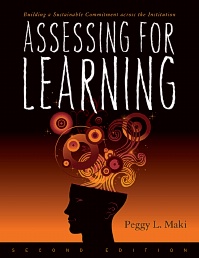
- Author
- Maki, Peggy L.
- Publisher
- Stylus Publishing, LLC, Sterling, VA
- ISBN
- 9781579224400
- Book Review Link
- http://onlinelibrary.wiley.com/doi/10.1111/teth.12033/abstract
- Table of Contents
-
Acknowledgements
Preface to the Second Edition
ch. 1 Developing a Collective Institutional Commitment
ch. 2 Beginning with Dialogue about Teaching and Learning
ch. 3 Making Claims about Student Learning within Contexts for Learning
ch. 4 Raising and Pursuing Open-Ended Research or Study Questions to Deepen Inquiry Into and Improve Student Learning
ch. 5 Identifying or Designing Tasks to Assess the Dimensions of Learning
ch. 6 Reaching Consensus about Criteria and Standards of Judgment
ch. 7 Designing a Cycle of Inquiry
ch. 8 Building a Core Institutional Process of Inquiry over Time
Appendix A: Institutional Example: University of Nebraska-Lincoln
Appendix B: Descriptions of Some Representative Commercially Designed Assessment Management Systems
Appendix C: Consent Form
While there is consensus that institutions need to represent their educational effectiveness through documentation of student learning, the higher education community is divided between those who support national standardized tests to compare institutions’ educational effectiveness, and those who believe that valid assessment of student achievement is based on assessing the work that students produce along and at the end of their educational journeys.
This book espouses the latter philosophy—what Peggy Maki sees as an integrated and authentic approach to providing evidence of student learning based on the work that students produce along the chronology of their learning. She believes that assessment needs to be humanized, as opposed to standardized, to take into account the demographics of institutions, as students do not all start at the same place in their learning. Students also need the tools to assess their own progress.
In addition to updating and expanding the contents of her first edition to reflect changes in assessment practices and developments over the last seven years, such as the development of technology-enabled assessment methods and the national need for institutions to demonstrate that they are using results to improve student learning, Maki focuses on ways to deepen program and institution-level assessment within the context of collective inquiry about student learning.
Recognizing that assessment is not initially a linear start-up process or even necessarily sequential, and recognizing that institutions develop processes appropriate for their mission and culture, this book does not take a prescriptive or formulaic approach to building this commitment. What it does present is a framework, with examples of processes and strategies, to assist faculty, staff, administrators, and campus leaders to develop a sustainable and shared core institutional process that deepens inquiry into what and how students learn to identify and improve patterns of weakness that inhibit learning.
This book is designed to assist colleges and universities build a sustainable commitment to assessing student learning at both the institution and program levels. It provides the tools for collective inquiry among faculty, staff, administrators and students to develop evidence of students’ abilities to integrate, apply and transfer learning, as well as to construct their own meaning. Each chapter also concludes with (1) an Additional Resources section that includes references to meta-sites with further resources, so users can pursue particular issues in greater depth and detail and (2) worksheets, guides, and exercises designed to build collaborative ownership of assessment. (From the Publisher)
This book espouses the latter philosophy—what Peggy Maki sees as an integrated and authentic approach to providing evidence of student learning based on the work that students produce along the chronology of their learning. She believes that assessment needs to be humanized, as opposed to standardized, to take into account the demographics of institutions, as students do not all start at the same place in their learning. Students also need the tools to assess their own progress.
In addition to updating and expanding the contents of her first edition to reflect changes in assessment practices and developments over the last seven years, such as the development of technology-enabled assessment methods and the national need for institutions to demonstrate that they are using results to improve student learning, Maki focuses on ways to deepen program and institution-level assessment within the context of collective inquiry about student learning.
Recognizing that assessment is not initially a linear start-up process or even necessarily sequential, and recognizing that institutions develop processes appropriate for their mission and culture, this book does not take a prescriptive or formulaic approach to building this commitment. What it does present is a framework, with examples of processes and strategies, to assist faculty, staff, administrators, and campus leaders to develop a sustainable and shared core institutional process that deepens inquiry into what and how students learn to identify and improve patterns of weakness that inhibit learning.
This book is designed to assist colleges and universities build a sustainable commitment to assessing student learning at both the institution and program levels. It provides the tools for collective inquiry among faculty, staff, administrators and students to develop evidence of students’ abilities to integrate, apply and transfer learning, as well as to construct their own meaning. Each chapter also concludes with (1) an Additional Resources section that includes references to meta-sites with further resources, so users can pursue particular issues in greater depth and detail and (2) worksheets, guides, and exercises designed to build collaborative ownership of assessment. (From the Publisher)