Home » Resources » Scholarship on Teaching » Adult Learning Methods: A Guide for Effective Instruction, Third Edition
Scholarship
March 29, 2017
Adult Learning Methods: A Guide for Effective Instruction, Third Edition
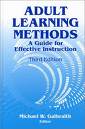
- Author
- Galbraith, Michael W., ed.
- Publisher
- Krieger Publishing Company, Malabar, FL
- ISBN
- B0047TF4K6
- Table of Contents
-
Part 1: Understanding and facilitating adult learning
ch. 1 The Teacher of Adults (Michael W. Galbraith)
ch. 2 Understanding Adult Learners (Huey B. Lang)
ch. 3 Exploring Your Philosophical Orientation (Lorraine M. Zinn)
ch. 4 Identifying Your Teaching Style (Gary J. Conti)
ch. 5 Designing Instruction (Gary J. Dean)
ch. 6 Understanding and Using Learning Styles (Waynne B. James, and Patricia A. Maher)
ch. 7 Creating Motivating Learning Environments (Raymond J. Wlodkowski)
ch. 8 Ethical Reasoning in Teaching Adults (Daniel D. Pratt)
Part 2: Methods and techniques
ch. 9 Guidelines for Selecting Methods and Techniques (Gary J. Conti, and Rita C. Kolody)
ch. 10 Case Story (Patricia Malsin-Ostrowski, and Richard H. Ackerman)
ch. 11 Discussion (Stephen D. Brookfield)
ch. 12 Lecture (Shirley J. Farrah)
ch. 13 Interactive Television (James E. Witte, and Maria Martinez Witte)
ch. 14 Distance Learning Techniques (Barbara A. White, and Cathy Bridwell)
ch. 15 Learning Contracts (Nancy O. Berger, Rosemary S. Caffarella, and Judith M. O'Donnell)
ch. 16 Course Portfolio (Barbara L. Nicholson)
ch. 17 Critical Thinking Techniques (Stephen D. Brookfield)
ch. 18 Demonstration and Simulation (Jerry W. Gilley)
ch. 19 Case Study (Victoria J. Marsick)
ch. 20 Forum, Panel, and Symposium (Burton R. Sisco)
ch. 21 Enhancing Learning Communities in Cyberspace (Michael J. Day)
ch. 22 Mentorship (Laurent A. Parke Daloz)
Index
Twenty-seven American academics and educational consultants contribute 22 chapters providing practitioners with an overview of adult learning, and practical information regarding methods and techniques for use in a range of educational settings. The third edition is oriented toward a more formal instructional environment than were previous editions. Some chapters from the second (1998) edition have been deleted, the remaining have been revised, and six new chapters added on designing instruction, understanding and using learning styles, motivation, interactive television, course portfolio, and creating learning communities. (From the Publisher)