Lessons from Queen B: Co-Learning and Contemporary Religiosity

This past summer, Beyoncé was on tour again. Her Cowboy Carter shows were filling stadiums, winning awards, and generating the kind of buzz only Queen B can. And every time I saw a headline about her latest performance, I was reminded of the time I found myself in a packed stadium, earplugs in place, swept up in the ecstatic roar of 80,000 fans – all because my students told me to go.
Sometimes co-learning means trusting your students. Sometimes it means doing the homework they assign – even if that homework is attending a Beyoncé concert.
From Early Polyphony to Pop Icons
Years before, I’d taken a different class to hear the world-class ensemble New York Polyphony perform Renaissance Marian music. The students were mesmerized. Five unaccompanied voices wove harmonies so rich and unexpected that one student turned to me, stunned, and said, “I didn’t know the human voice could sound like that.”
The texts were sacred, the music deeply devotional, and yet what struck the students most wasn’t the sixteenth-century solemnity but the encore: a playful barbershop version of Rosie the Riveter. Somehow, that moment – a bridge between sacred history and cultural familiarity – made the entire evening resonate. The music stopped feeling like an artifact and became a living conversation between past and present.
That night stayed with me, a reminder that context matters. And a few years later, when I wrapped up a course on religion and popular culture, I asked my students a question I have always asked since:
“What should I explore to better understand the worlds you inhabit?”
Their response came quickly: “Go to an arena concert. And not just any concert – Beyoncé, Drake, or Kanye.”
Enter the Beyhive
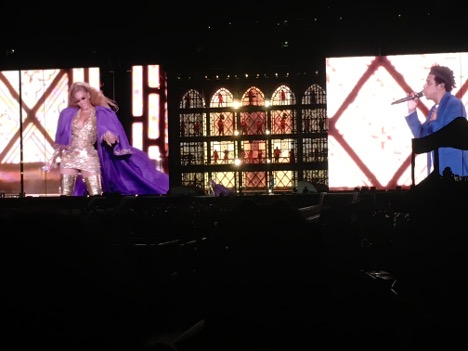
So, in the summer of 2018, I booked a ticket, crossed the border from Canada, and joined 80,000 members of the Beyhive in Ohio Stadium for the On the Run II tour with Beyoncé and Jay-Z.
From the first moment – when the Carters descended from above, dressed in white, declaring their enduring love – it was clear this was not just entertainment. This was ritual.
The show unfolded as a narrative arc of love, betrayal, repentance, and redemption. Paradise gave way to heartbreak, scenes of confession and prayer played out in a candlelit chapel, and a climactic celebration of forgiveness transformed the stadium into something resembling a cathedral.
And the crowd? They weren’t passive observers. They sang every lyric, moved in unison, and cried openly. It felt like full, conscious, active participation – the kind of embodied engagement we often hope for in sacred spaces but rarely see.
When Beyoncé Became an Icon – Literally
What stayed with me most was the imagery. Midway through the concert, Beyoncé appeared in shimmering purple and gold, styled unmistakably as an Orthodox Pantocrator – an icon of Christ enthroned. She even raised two fingers, echoing the gesture indicating divine and human natures.
In that moment, the conversation between Christianity and contemporary culture could not have been clearer. Here was a global superstar, embodying centuries-old sacred iconography in a performance consumed by millions. Fashion, music, and religious symbolism were colliding to create something profoundly resonant, and my students had sent me there to see it for myself.
Shifting My Perspective
I returned to the classroom that Fall with fresh eyes. Co-learning had always been central to my pedagogy, but stepping fully into my students’ cultural world shifted something.
I began paying closer attention to themes of celebrity, cultural authority, and the theological undercurrents embedded in popular culture. I started inviting students to share more of their own frameworks and interpretations, realizing that they weren’t just consumers of culture but skilled analysts of its meanings.
The experience also expanded my understanding of how religion permeates the spaces we often call “secular.” The concert was not just a performance; it was a pilgrimage – complete with shared anticipation, communal solidarity, and a sense of collective transformation. And, like pilgrimage traditions past, it was also monetized: tickets, merchandise, exclusivity all wrapped into a deeply spiritual-yet-commercial exchange.
The Power of Reciprocal Learning
Today, when I teach courses on religion and culture – or on pilgrimage, as I did this past academic year – I think about that night in the stadium. The walk toward the venue with thousands of others felt uncannily like the approach to a sacred site. The sense of communitas – a shared, egalitarian solidarity – buzzed in the air, reminding me that cultural experiences can be as spiritually charged as traditional rituals.
Students directing the narrative of their own engagement, I’ve realized, is the real power of co-learning. I don’t hand them neat interpretations of the world; instead, we create frames together. Their insights push me to reimagine my own assumptions, and in return, they see their cultural knowledge valued as part of the academic conversation.
For me, that Beyoncé concert wasn’t just a field trip. It was a lesson in humility, curiosity, and the unexpected ways learning happens when we let students lead.
And as I watched news of Cowboy Carter lighting up stadiums this summer, I was reminded to keep asking my students: “What should I see next?” Because if there’s one thing I’ve learned, it’s that the richest pedagogical journeys often begin when we’re willing to follow.
About Andrew P. Wilson
Andrew P. Wilson is Associate Professor of Religious Studies at Mount Allison University in the Canadian Maritimes. Guided by the principle that “together we’re smarter,” his teaching and scholarship thrive on building connections – between people, ideas, and communities. In the classroom, he bridges seemingly distant worlds, bringing popular culture into dialogue with religious doctrine to dissolve boundaries, shift perspectives, and spark fresh insights. Beyond campus, he works with a wide range of community partners to foreground collaboration and engagement in learning. His research explores the intersections of religion, culture, and creativity, with publications ranging from Critical Entanglements: Postmodern Theory and Biblical Studies (Brill, 2019) to recent work weaving together family story, biblical text, and contemporary art. In recognition of his innovative teaching and leadership, he received the 3M National Teaching Fellowship in 2021, Canada’s highest honor for excellence in education.