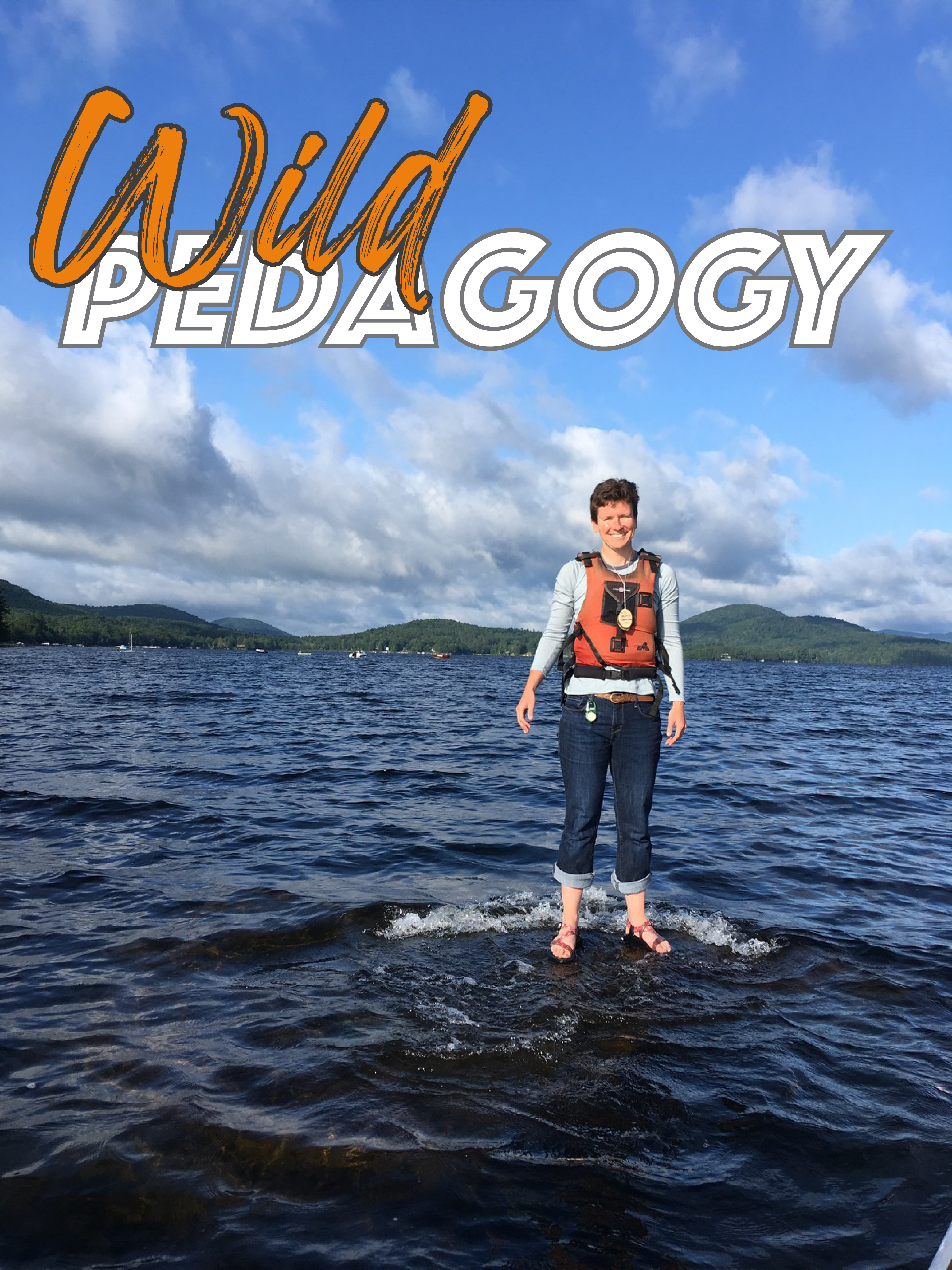
I think I’ve mentioned before in this blog series that all the most important things I learned about teaching I learned while working as a wilderness guide at a children’s camp in the Adirondack Mountains during seminary and grad school. This is one of the reasons teaching outside makes so much sense to me. It’s why I expend so much effort trying to create immersive outdoor classes. It’s the form of teaching I know best: teaching as guiding.
We all have images of ourselves as teachers. I’ve heard colleagues talk about teaching as midwifery, coaching, even zookeeping (a middle school teacher friend). Guiding is a common image, of course, but my personal guiding experience influences how I think of my work: be infinitely flexible, handle challenging questions, inspire students to greater curiosity, provide boundaries for safety both physical and metaphorical, read a group, shape group dynamics, facilitate conversation, empower students to learn for themselves, love even the unlikeable students, and, perhaps most important of all, when it rains, let it, then go out and remember your baptism.
This is what teaching outside has done for me. It has not just provided space for a good class session but shaped the very way I imagine myself as a teacher. Teaching outside is wilder, less tamed, less regimented and institutionally rule-bound than teaching in the classroom, at least to me. I hope to be a wilder, less predictable teacher. Not in the way that makes students anxious because they can’t figure out what’s being expected of them at any given moment or because they’ve never been given a syllabus (I have very detailed syllabi and provide much structure to curb anxiety), but in a “you can’t shock me” way. Just last week, on the second day of the semester, when I asked an undergraduate gen ed class “What do you think the Bible is?” a student looked at me a little sideways, testing, and said, “A book of ancient ideologies created to support the patriarchy.” I smiled wide and said, “Yes! Let’s talk about that!” And though the rest of the class wasn’t quite sure what to do or whether I was Christian enough to be teaching a Bible class, this one firecracker of a student found her place in a real conversation – encouraged and challenged both – because I received her in a way she wasn’t expecting. Then she really got to learn.
Playfulness and saying yes as often as I can is part of my identity as outdoor-teacher-guide too. When students ask, “Can we have class outside?” thinking that they will be told no because their other teachers say no, I say, “Yes!” When a student asks if they can make a video for the in-class project instead of drawing on the board, I say, “I can’t wait to see it!” Students sometimes ask for things they feel are breaking the rules, or try to get away with something, but when I can say yes, they find they have some agency and can participate in their own learning. In fact, though I don’t often point it out to them lest it make them less willing, their participation makes them learn better and more deeply.
Guiding and teaching outdoors has also made me curious. I once marveled at a pool of mud on a mountaintop in the pouring rain with a friend when we discovered that the mud shimmered and became different shades of yellow depending on where we stood. I hope my students develop that kind of curiosity – and find that kind of friend – for themselves. My posture of wonder and curiosity in the classroom ought to demonstrate for them: “Why do you think that?” “What kind of bug is that?” “Tell me more about your perspective.” “How could we solve this?” “What else could that mean?”
Many of my former campers are now grown up. Not only have they served as wilderness guides themselves, but they have gone on to get “real” jobs. A few still write letters, and I love to hear from them. I love hearing how they are becoming fully themselves and leaders in their communities: wild, playful, curious people who get to form others. It’s a delight to learn that I am no longer needed. It is a deeper delight still that they allow me to glimpse their triumphs. They still sign their letters, “Your camper, Tim.” I still sign my letters, “Always your guide, Aunt Samantha.” Tim has suggested that I cover the name plate on my office door with a sign that reads, “Dr. Aunt Samantha.” Perhaps I should take this under consideration. It is who I most am.
What environments have shaped your image of yourself as a teacher? What outside-the-classroom work has given you aspects of yourself that transfer into your posture as a teacher? What should your office door read?
About Samantha Miller
Samantha L. Miller (Ph.D., Marquette University) is an assistant professor of theology at Whitworth University and has written Chrysostom's Devil: Demons, the Will, and Virtue in Patristic Soteriology (IVP, 2020) and John Chrysostom and African Charismatic Theology in Conversation: Salvation, Deliverance, and the Prosperity Gospel (Lexington, 2021). Her favorite class to teach is Backpacking with the Saints, and to her dean's delighted bewilderment, she can be found more often than not teaching, writing, and holding office hours outdoors, once teaching a walking class in 10 inches of snow.