Resources
We are celebrating the 50th anniversary of Paulo Freire’s magnificent book Pedagogy of the Oppressed and the Wabash journal, Teaching Theology and Religion, has published a Forum to to celebrate the book and Freire’s legacy. Very few books in recent history have made their way around the world expanding the ways people think about education and learning processes. Freire’s legacy is one that will always be developed and challenged. Developed by those who care for deep, critical thinking and challenged by people and governments who see the danger of Freire’s thinking. Regarding the latter, Jair Messias Bolsonaro, the new president of Brazil, where Paulo Freire is from, sees a danger in Freire’s work and legacy. While campaigning, the new president said that he would go into the Ministry of Education with a flame-thrower to burn anything associated with Paulo Freire. Even though Mr. Bolsonaro most probably has never read any of Freire’s books, he claims that Freire offers a sectarian and socialist education whose Marxist teachings undermine the education of the student. Along with Bolsonaro, the Brazilian new conservative movement called “Schools Without a Party” also blames Freire for making students receptacles of ideologists who want to put socialist interests before the love of Brazil and threaten the “Christian values” of family, property and church. It is with good reason that the president of Brazil and conservative sectors of society are all concerned with Paulo Freire. Freire’s education helps people to figure out their own lives more fully, to develop critical minds, to engage into social mobilization, to gain their own sense of liberation, and become subjects of their own history. This process helps people to see, judge and act, challenging all forms of power. Education for Freire is the unfolding of worlds for the one who is learning. It is a way to gain conscientization of one’s own life and the environment in which one lives. When Paulo Freire is teaching a village of fishers, he starts by asking people “what is a fish?” Then he asks what is the meaning of the fish to the community, and how fish and fishing are connected with their own ways of living, as well as how they relate with other fishing villages, the environment, and even big fishing companies. Through pursuing the meaning of the word “fish,” the fishers describe several power relations around their lives. In the end, people learn not only how to spell and write “fish,” but also how “fish” tells people about their lives, their world, and the other worlds with which they are connected. Done this way, education is a path from being oppressed to become free. Education is a way of giving voice to the voiceless and gaining conscientization that unleashes the struggle against the domination of those in power, of realizing that everyone has the strength to organize and struggle to change their lives. This form of education is everywhere in the world and as educators we must go where transformation is at work. In order to continue to honor Paulo Freire, we must acknowledge that popular education is present in the movements of resistance and emancipation. For us to get a better sense of what Freire’s pedagogy can do, we should listen to those who are at the bottom of society trying not only to survive, but to thrive. It is from those places that we gain a much better sense of what Freire’s pedagogy of the oppressed means. As Oscar Soto says: The popular education of Paulo Freire is the possibility that workers, peasants, landless workers, excluded and marginalized people will think and re-invent themselves in the transit from being spectators to become genuine creators of the material conditions of life. It is not in vain that the language of the pedagogical rebellion of the oppressed is spoken in the popular movements, in the base communities, in the theories of dependencies, the sociologies of exploitation, the liberation theologies, the Latin American socialisms, the research/activism, participatory action and so many traditions of resistance in Our America.[1] On the other hand, Freire’s pedagogy can also be relevant for teaching contexts with privileged students in elite universities. It can help students gain a sense of vincularidad[2] or deep relationality, of unbalanced power, exploitation, and class struggle. By gaining consciousness of our lives in the relation with others and larger societies, we learn how to act towards somebody else, and move from protecting our own groups into seeking common justice for all. This opening of the world of oneself into the world of another brings a demand with it, namely that we engage in each other’s worlds. What happens then is that I have to check how my own ways of thinking and living are related to other forms of thinking and living, how my habits of eating fish relate to fishing villages and the massive destruction of the sea life by big corporations. This consciousness of our common situation and the fundamental sense of vincularidad challenge teachers and students in any school, poor or rich, to engage in uneven exchanges. Freire’s education for consciousness is the beginning of the unfolding of a vast world of wonders and imperfections that need to be engaged. For instance, if we want to deeply honor Paulo Freire and his legacy, we must respond to one of the most fundamental challenges of our times: patriarchy/fascism and the “masculine mandate.” Rita Laura Segato calls our attention to the war against women and how the new forms of fascism are aimed at the destruction of the women.[3] How can we engage pedagogies of liberation that help us engage and relate with this those being oppressed by it? How can we find tools, together, to understand it and create conditions of possibilities for transformation? Our lives, and the life of our planet, depend on forever-expanding forms of conscientization that keep demanding freedom, and justice for every person. In this way, the work of Paulo Freire, developed by the work of women, indigenous voices and popular movements, can reach any and every school and community, connecting us deeply with the work of Martin Luther King who said “Injustice anywhere is a threat to justice everywhere. We are caught in an inescapable network of mutuality, tied in a single garment of destiny. Whatever affects one directly, affects all indirectly.” (Letter from Birmingham Jail) [1] Oscar Soto, Freire, Mariategui y una educación popular campesino, Noviembre 22, 2018, http://contrahegemoniaweb.com.ar/freire-mariategui-y-una-educacion-popular-campesina/ [2] Walter D. Mignolo and Catherine E. Walsh, On Decoloniality: Concepts, Analytics, Praxis (Durham: Duke University Press Books, 2018). [3] Rita Laura Segato, La Guerra Contra Las Mujeres (Madrid: Traficantes de Sueños, 2016).
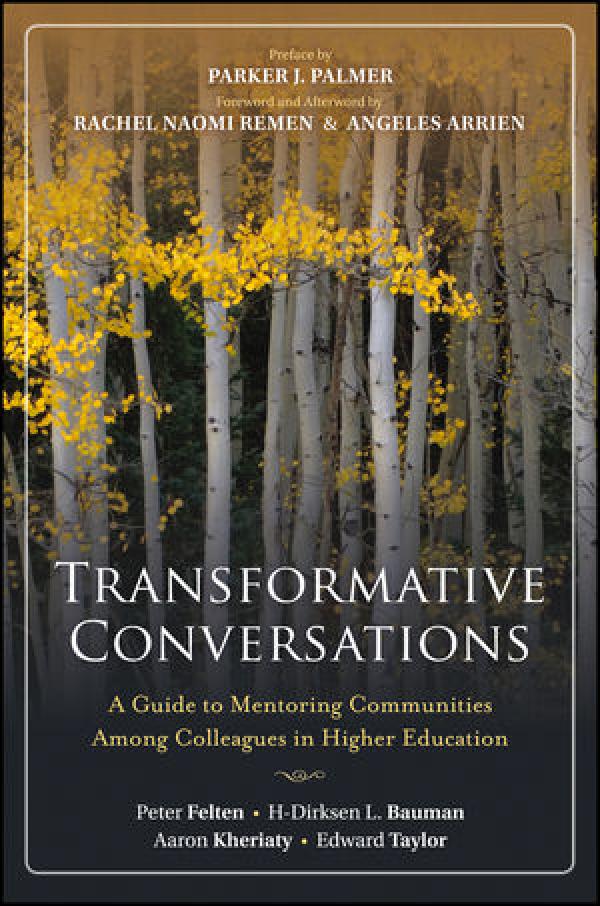
This book stands out for its simplicity of style, transparency of voice, and modesty of ambition. It makes an argument about the power of intentional “mentoring communities,” composed of peers at different stages of career. The authors ground the argument in their experience participating in such a community under the auspices of the Fetzer Institute and also organizing and participating in mentoring communities on their own campuses over a two-year period. Their conclusion: mentoring communities, by supporting and challenging their members to “identify and reconnect to their core values, revitalize their individual dreams, and renew their commitment to goals that serve as the foundation for their work and their lives,” help their members orient their choices and creative projects around their deep purposes and values, and so animate, from within the group, reform in higher education (5-6, 31, 87-88). The authors demonstrate what too few believe: that the solution to what ails higher education, in no small part, lies within the people whose vocation it is to teach and support students’ learning. The transparency of their reporting and reflection on experience lends credibility to the authors’ argument – they “show” far more than they “tell.” The authors refreshingly avoid both indulgence in lament and speculative grand proposals. In language free from jargon yet saturated with the vibrancy of lived experience, they provide a readily accessible “how to” for initiating mentoring communities. These are decidedly not committees, which have “institutional mandate[s] and goals,” or therapeutic groups – which focus on “participants’ emotional wounds and disorders” (20-21). Rather, they are groups of four-to-six colleagues who commit to mutual mentoring, with the intention of helping “participants explore, form, articulate, and live out of their values” (21). The groups focus on “strengths and virtues” not “wounds and weaknesses” (21). The authors refer to these communities as “formation mentoring communities,” using the term “formation” to highlight the orientation around helping members develop as whole persons, cultivate “shared human capacities,” and advance “each person’s particular gifts and talents” (14-15). This slim volume is a superb guide to preparing groups to enter into and sustain serious conversation. In four short chapters the authors describe mentoring communities, elaborate on the practice of conversation, explain how to organize a mentoring community, and illustrate how to do collaborative leadership in the groups. In the last chapter they argue for the centrality of such communities to any serious institutional change in higher education. The authors also provide a rich bibliography of resources on education, convening and facilitating, dialogue and conversation, formation and spiritual direction, mentoring, and community. While not directed explicitly to theological education or religious studies in the liberal arts, deans, department and program heads, and faculty in these settings should read this book. It will provoke thinking regarding and offer strategies to those desirous of welcoming new colleagues into institutions; those wanting to provide better support for colleagues contemplating the next phase in career or life; those wanting to support graduate students; and those concerned with how to compose more satisfying, sustainable, meaning or purpose-anchored lives across the career span.