Resources
One of the great paradoxes of my life at the moment is that I am writing a textbook (on religion and disability) while slowly moving away from using textbooks in my own courses, from lower-level intro classes to upper-level electives. Textbooks have been hard to wean myself from. They are so helpful, so convenient, so… soothing. I feel comforted knowing they have been authored and edited by people who I always assume are way more expert than me. (Hello, imposter syndrome!) I feel like I can assume some standard of quality, accuracy, and coherence. It certainly takes me way less time to decide which one textbook to require than it does to search for and sift through dozens of case studies or examples drawn from books, scholarly journals, news outlets, personal blogs, YouTube videos, Netflix movies or shows, social media, university webpages, local religious sites, podcasts, Google images, Spotify playlists, guest speakers, and more. I find it so easy and efficient to lay out my course schedule with different textbook chapters corresponding to different units, weeks, or days. The tests fall, similarly, smoothly into place. (Sometimes the textbooks even provide tests for us, so we don’t have to create them ourselves!) Likewise, the students just have to keep track of one thing. So why am I starting to move away from them? Well, for one, they can be extremely expensive. Search around online and you come across the word “scam” pretty quickly in discussions, articles, and sites devoted to textbooks. My university now even has a place in the students’ registration system where classes that have low-cost or no textbooks are clearly indicated. Of course, some things are worth a high sticker price—for example, the Trek mountain bike I’ve used exactly twice, obviously—but if we’re wanting higher education to be available to everyone, cost must be a consideration. As inclusive as this rationale is, however, I have to admit it isn’t my main motivation. Rather, I fear textbooks give students the erroneous impression that all there is to know about a particular religion (or any other subject) can be found in those thirty or so pages of each written chapter. After all, it’s supposed to be an introduction! As if the material is complete, comprehensive, and closed. Yet some textbooks spend too much time on one religion (Christianity, usually), while neglecting others. I like Religion Matters a lot, for example, but the current version doesn’t contain anything on African religions—an omission I’ve heard its author, Stephen Prothero, is rectifying in the next edition. Or, some textbooks, in an attempt to fulfill their presumed charge of trying to capture an entire religion in the limited space allotted, end up making sweeping generalizations, like “all Muslims must…,” which contradicts exactly what I’m trying to teach students about the diversity of all religious traditions. Of course, I can—and do—point out the problematic nature of such assertions to my students, but still…. Textbooks are also written works, though they may be supplemented with beautiful visuals and online materials. Yet, as Jin Young Kim writes in “Embodying World Religions in the Classroom,” religion is a lived sensory experience. David Morgan’s publishing career has been basically one big reminder of the material nature of religion (through books, of course!). Some religions like Hinduism, textbooks will even claim, are more about practice and experience than any specific set of beliefs, dogmas, or creeds. But, of course, Muslims move when they pray. Meditation involves the body, the breath. Challah is eaten. The Vatican is a place people go. What impression do we leave with students, then, if our predominant material for class is the written word? This bias can be especially distorting when dealing with traditions that are primarily oral. I was able to find a written source for Little Dawn Boy, a Navajo story about disability, but the one-page PDF was not nearly as captivating, or illuminating, as watching and listening to Navajo member Hoskie Benally, Jr., tell the same story. Guess which one I assigned to my students this term? Students also get the unfortunate idea from textbooks that there is only one position—the author’s/authors’—to hold about whatever topic is being addressed. The textbook was written by experts, after all, professors with PhDs. Who could argue with them? Textbook authors sometimes try to stave off this problem by including phrases like “scholars disagree” or “some scholars believe,” but in the absence of multiple sources or examples, I have watched such nuances go right over students’ heads. Sometimes I find myself assigning excerpts from different textbooks, just to show students discrepancy and debate, to clarify that even experts disagree, and to convey how a field can evolve in its understanding of a subject. I also fear that textbook use is out of alignment with my general approach to teaching, which is less lecturey and more interactive. Using a textbook seems like it supports an older “sage on stage” model, where we, the masters of a subject, convey our vast wisdom (in books and from behind lecterns) to the passive recipients in our courses, our naive and novice students. Read Chapter 1, pages 3-19. Take notes on what the professionals think. Study the key terms in the glossary (further condensed into one paragraph for ease!). Listen to the lecture. Download the PPTs. Take the test. You’re all set. Of course, textbooks usually have study questions at the end, and of course, professors can enliven or shift this process to become more dialogic in their classrooms, building off of or troubling what the textbook presents. But, in general, the way most textbooks are written still feels a bit too one-directional to me. This brings me to my final point, which is that a lot of textbooks are booooooring. For as much as they try to be exciting, with their images and interviews and bolded terms and online supplements, they sometimes just aren’t. Students struggle to get through the assigned material, the overviews of millennia’s worth of global history can be overwhelming and convoluted, there are a lot of specifics to sort through, and the relevance and applicability is not always clear. Now, I’m not saying learning always is, or always has to be, exciting. Sometimes you just have to put in the time, grind it out, do it for the extrinsic motivation. And I’m certainly not a proponent of the edutainment/edutainer idea. But I do think learning has the potential to be interesting, provocative, thrilling, even. After all, how many of us got into the field because we found it…dull? Many of these issues are what I’m trying to remedy in my own textbook, filling it with more questions and prompts than with answers and assertions, crafting prose that sounds more like casual conversation with a co-learner than a data dump from a master, including invitations and encouragements to seek out media and experiences elsewhere, presenting disagreements and differences of perspective. Until more textbooks approach their subjects in this way, I’m afraid I am going to have to let them go.
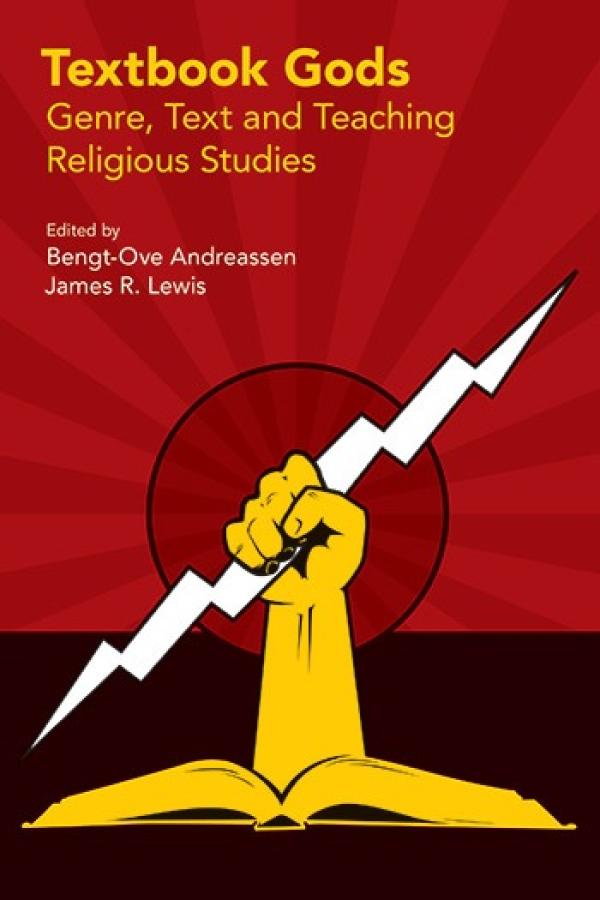
Textbook Gods is a collection of essays by predominantly European scholars of religion on the use of textbooks in primary, secondary, and post-secondary educational settings. Textbooks are understood to be books written primarily for classroom teaching that convey “key knowledge” within a given academic discipline (2). As such, textbooks generally present disciplinary knowledge as stable, firmly established, and definitive. The essays in this volume wrestle, first, with the problems of bias and essentialism in such authoritative, institutionally-sanctioned books. By extension, they also consider the impact of religious studies textbooks in reproducing knowledge of religion in the public sphere. Satoko Fujiwara argues in her essay, for instance, that the religion textbooks used in secular Japanese public schools prioritize world religions over ethnic religions and provide monothetic and essentializing accounts of these religions (for example, Christianity is love, Buddhism compassion, Islam obedience). Likewise, in their contributions James Lewis and Carole Cusack criticize textbooks for validating students’ ethnocentric prejudices about sub-Saharan African religions and aboriginal Australian religions. In a somewhat different vein, Bengt-Ove Andreassen critiques the way that introductory Norwegian textbooks present “religion” as a positive, universal phenomenon that is necessary for human fulfillment and flourishing. Other essays have a more methodological focus, discussing the ways that scholars of religion can assess religion textbooks, both as teaching resources and as indices of the status of scholarship on religion. Katharina Frank outlines a theoretically-informed methodology for assessing the ways that a new Swiss world religions textbook frames the phenomenon of religion. Mary Hayward surveys the use of visual aids in four textbooks that are used in England’s secondary school religious education courses, tabulating types of images and their relation to the text. She calls for a stronger interrelation between text and image because the privileging of text mirrors the privileging of the intellectual over the material in the study of religion. The essays in this volume are generally of good quality: they are well written, they fully contextualize the textbooks that they discuss, and they engage contemporary debates in the scholarship of religion (for example, on the public role of religion in secularizing societies; on the utility of “religion” as an analytical category). This volume should not be seen as an aid for teachers of religion who are considering which textbooks to use in their classes. Though the essays in it discuss many different textbooks at length, the primary topic is not their specific merits and demerits, but rather the role of textbooks as a genre in the production of public knowledge of religion. I would strongly recommend this book for experienced scholar-teachers who are reconsidering how they use textbooks, or even if they should use textbooks at all. The range of materials covered by the essays, and the diversity of opinions they present, make Textbook Gods a valuable resource.