Resources

Originally, I was planning to write about “decolonizing”—our syllabi, our curriculum, our teaching. I had a title and everything. Thankfully, though, a colleague reminded me of Tuck and Yang’s important article “Decolonization is Not a Metaphor” (2012) and their argument that “decolonization brings about the repatriation of Indigenous land and life; it is not a metaphor for other things we want to do to improve our societies and schools.” In a related post entitled “Do Not ‘Decolonize’… If You Are Not Decolonizing: Progressive Language and Planning Beyond a Hollow Academic Rebranding,” Nayantara Sheoran Appleton writes of how “decolonizing has been co-opted from a vibrant and critical engagement to an academic buzzword” and how such hollow engagement is “sloppy and opportunistic.” Ouch. And . . . she was right. I was planning to use “decolonization” in this more metaphorical sense, because it’s a popular term right now, but with no intention, as Tucker and Yang write, of mentioning “Indigenous peoples, our/their struggles for the recognition of our/their sovereignty, or the contributions of Indigenous intellectuals and activists to theories and frameworks of decolonization.” I’m thankful for this kind of “call in.” Okay, so what was I actually trying to write about then? Fortunately, Appleton offers labels for other valuable pedagogical efforts we might be pursuing (all, delightfully, d-words too): “diversify your syllabus and curriculum; digress from the cannon; decentre knowledge and knowledge production; devalue hierarchies; disinvest from citational power structures; and diminish some voices and opinions in meetings, while magnifying others.” Aha. It turns out what I was trying to work on was diversifying. In these efforts, I am guided by this “Inclusion by Design” tool, a worksheet for surveying your syllabus and course design, which was created by some of my very favorite colleagues (and which they’ve helpfully summarized in this Faculty Focus). Some questions from this self-evaluation tool that I use to critically examine my own teaching include: To what extent do some of the learning objectives aim at diversity- or inclusion-related knowledge, skills, or attitudes? To what extent do teaching activities meet the needs of diverse learners . . . ? To what extent do the course materials, such as readings, provide a full spectrum of perspectives on topics? To what extent does the course material represent a variety of voices? What unwritten messages does the syllabus convey about the course, content, and learning? Is there a “hidden curriculum” embedded in the syllabus? I appreciate the wide range of considerations that the tool offers here, from learning outcomes to teaching activities to course materials to even what might be “hidden.” In our course materials, it’s far too easy to march a parade of white, “Western,” men in front of our students: Durkheim, Eliade, Frazer, James, Tylor, Girard, Marx, Freud, Weber, Geertz, Smart, Tweed, J.Z. Smith, Wilfred Cantwell Smith, Huston Smith, all the Smiths. How can I move beyond, or offer critiques of, this “canon,” to allow my students to consider other important contributions to (and omissions or silences from) the field? In my assignments, how do I privilege certain ways of knowing or representing that knowledge and how can I do differently? Do I inadvertently embody the characteristics of white supremacy culture, such as worship (no pun intended!) of the written word, in the way I organize class discussions, arrange our schedule, create my rubrics? And, of course, questions about my particular syllabus or learning environment can’t help but lead me to reflect on our field, as a whole. It’s no secret that theology and religious studies have some Christian, colonial baggage. (I like assigning the first part of this Schilbrack article to students on this very point.) There are no easy answers for any of us here—and I don’t imagine that I’ll have this all sorted out in the next month, by the time the new academic year begins. What I am committed to is this kind of critical examination and the diversification—not yet the decolonization—of my own teaching. Will you join me?
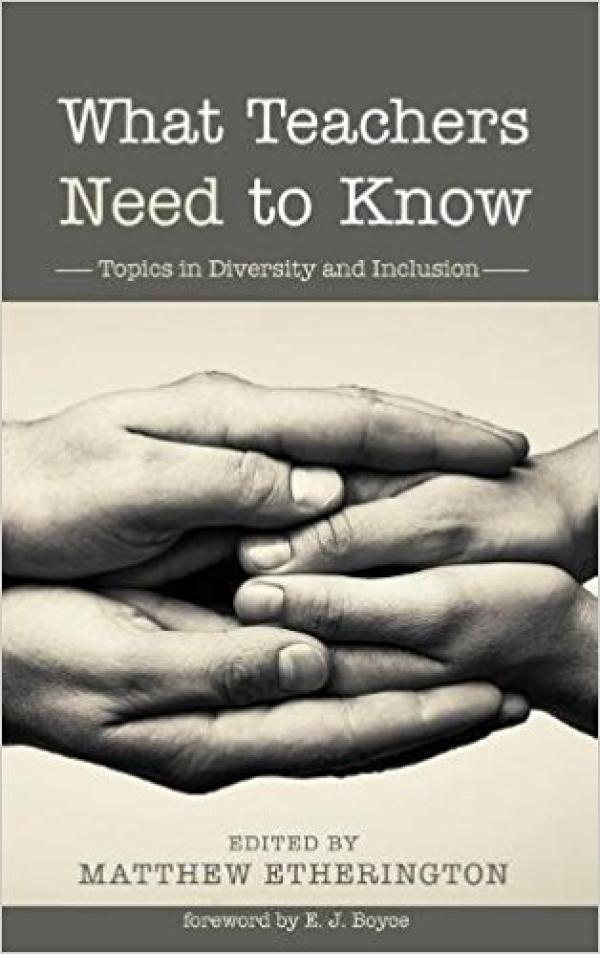
What Teachers Need to Know (Etherington, 2017) is a substantial text defining the diverse and inclusive experiences of contemporary education systems. The book is a compilation with three major parts: “Ethics,” “Inclusion and Teacher Management,” and “Worldview and Story.” Each chapter provides reading questions for use in a classroom setting or for deeper reflection. This is well-suited for an audience in higher education, especially for readers who could share personal experiences with diversity and inclusion topics after a practicum or time teaching. I would recommend this book for a post-graduate education library. The first part, “Ethics,” includes works by Sherick Hughes, Martyn Rouse, Jonathan Anuik, Chet Bowers, Eva Maria Waibel, the editor, Matthew Etherington, and James Dalziel. There is quite a range of topics in this section, but the Wabash Center reader might be particularly interested in Anuik's essay on faith-informed discourse. It is a study about the influence of missionary education on Indigenous beliefs, and how that reaches into Canadian public education today. It compels the reader to contemplate whether church and state can truly be separate in an educational context when there is such a significant inheritance of practice and values from a period dominated by religious influence. Part Two, “Inclusion and Teacher Management,” includes works by Peter J. Froese, Ken Pudlas, Lucinda Spaulding, Karen Copeland, Bruce Shelvey, and Ken Bradley. Spaulding's essay reflects the current shift of attention to patterns of bullying and puts forward the mechanisms school communities can provide for the resiliency of the students. Other essays in this section discuss topics such as mental health, special needs, and even bring in the parents' view on these issues as they exist in the educational system. This is an exceptional collection of essays on inclusivity. The third and final part, “Worldview and Story,” includes works by the editor, Matthew Etherington, Edward R. Howe, Adam Forsyth, Leo Van Arragon, Christina Belcher, and Cynthia à Beckett. This section has the most obvious correlation to religious studies within educational contexts. Topics include: tolerance, science and religion, and epistemology. This section could serve as an excellent initial reading for students in a practical theology or other contemporized religious studies capstone course. This book might not be a comfortable read in a public classroom, but maybe that is exactly why it should be read. Etherington's compilation offers academic theological reflection for secularized educational contexts. This book could be useful in a range of contexts. It may be particularly helpful to new teachers, parent associations, pastors of students, and community leaders.