Resources

Originally, I was planning to write about “decolonizing”—our syllabi, our curriculum, our teaching. I had a title and everything. Thankfully, though, a colleague reminded me of Tuck and Yang’s important article “Decolonization is Not a Metaphor” (2012) and their argument that “decolonization brings about the repatriation of Indigenous land and life; it is not a metaphor for other things we want to do to improve our societies and schools.” In a related post entitled “Do Not ‘Decolonize’… If You Are Not Decolonizing: Progressive Language and Planning Beyond a Hollow Academic Rebranding,” Nayantara Sheoran Appleton writes of how “decolonizing has been co-opted from a vibrant and critical engagement to an academic buzzword” and how such hollow engagement is “sloppy and opportunistic.” Ouch. And . . . she was right. I was planning to use “decolonization” in this more metaphorical sense, because it’s a popular term right now, but with no intention, as Tucker and Yang write, of mentioning “Indigenous peoples, our/their struggles for the recognition of our/their sovereignty, or the contributions of Indigenous intellectuals and activists to theories and frameworks of decolonization.” I’m thankful for this kind of “call in.” Okay, so what was I actually trying to write about then? Fortunately, Appleton offers labels for other valuable pedagogical efforts we might be pursuing (all, delightfully, d-words too): “diversify your syllabus and curriculum; digress from the cannon; decentre knowledge and knowledge production; devalue hierarchies; disinvest from citational power structures; and diminish some voices and opinions in meetings, while magnifying others.” Aha. It turns out what I was trying to work on was diversifying. In these efforts, I am guided by this “Inclusion by Design” tool, a worksheet for surveying your syllabus and course design, which was created by some of my very favorite colleagues (and which they’ve helpfully summarized in this Faculty Focus). Some questions from this self-evaluation tool that I use to critically examine my own teaching include: To what extent do some of the learning objectives aim at diversity- or inclusion-related knowledge, skills, or attitudes? To what extent do teaching activities meet the needs of diverse learners . . . ? To what extent do the course materials, such as readings, provide a full spectrum of perspectives on topics? To what extent does the course material represent a variety of voices? What unwritten messages does the syllabus convey about the course, content, and learning? Is there a “hidden curriculum” embedded in the syllabus? I appreciate the wide range of considerations that the tool offers here, from learning outcomes to teaching activities to course materials to even what might be “hidden.” In our course materials, it’s far too easy to march a parade of white, “Western,” men in front of our students: Durkheim, Eliade, Frazer, James, Tylor, Girard, Marx, Freud, Weber, Geertz, Smart, Tweed, J.Z. Smith, Wilfred Cantwell Smith, Huston Smith, all the Smiths. How can I move beyond, or offer critiques of, this “canon,” to allow my students to consider other important contributions to (and omissions or silences from) the field? In my assignments, how do I privilege certain ways of knowing or representing that knowledge and how can I do differently? Do I inadvertently embody the characteristics of white supremacy culture, such as worship (no pun intended!) of the written word, in the way I organize class discussions, arrange our schedule, create my rubrics? And, of course, questions about my particular syllabus or learning environment can’t help but lead me to reflect on our field, as a whole. It’s no secret that theology and religious studies have some Christian, colonial baggage. (I like assigning the first part of this Schilbrack article to students on this very point.) There are no easy answers for any of us here—and I don’t imagine that I’ll have this all sorted out in the next month, by the time the new academic year begins. What I am committed to is this kind of critical examination and the diversification—not yet the decolonization—of my own teaching. Will you join me?
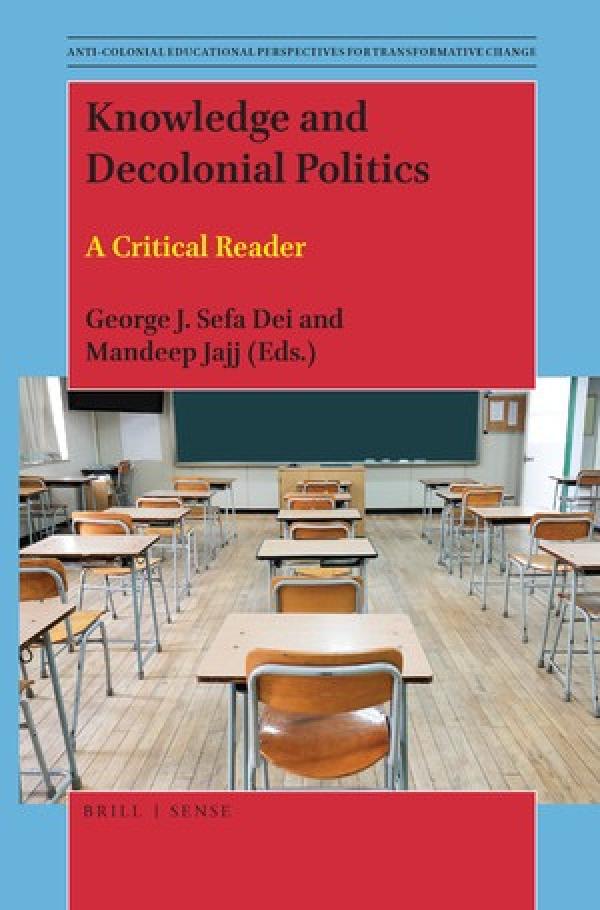
Decolonization as an epistemological framework remains a pressing topic. Decolonization challenges the insidious ways in which colonialist ideologies persist as neo-colonial manifestations in economic, political, military, judicial, educational, and spiritual spheres, among others. The series of essays in Knowledge and Decolonial Politics address different challenges within the educational system in Canada. The goal of the book is to address “intellectual colonialism” by decentering Western hegemonic ontology, epistemology, rhetoric, and policies (4-6). As the introduction claims, the “book intends to expose and challenge Western knowledge systems, and dominant political systems, and their role in subjugating, marginalizing, and oppressing local and Indigenous knowledges” (4). After the introduction, the remaining seven chapters each consider a separate issue in need of decolonization with regard to pedagogy: dismissiveness of indigeneity in the curriculum, the classroom, rhetoric of “development,” land ethics, spirituality, spirit-body unity, and indigenous languages. Each of the chapters addresses a topic that is essential to the experience in the classroom, and which requires critical reflection from both teachers and students. As an edited work, the interconnectedness of the chapters sets up a promising framework. The authors point out major weaknesses in the Canadian educational system which fail to prepare teachers and students to engage anti-discriminatory and anti-racist discourses and pedagogies. Despite the legal advancements and robust rhetoric in official documents, much remains to be implemented inside the classroom. The essays call for integrating various ways of knowing that are attentive to non-western cultures in order to challenge meaningfully the Eurocentricity of the curriculum. It would have been beneficial throughout the essays to include specific references to actual indigenous communities and values. Many of the indigenous values mentioned remained in the abstract. Interesting points of contact with African indigenous values were raised in a few of the essays, but were underdeveloped (chapters four, six and eight). Wambui Karanja’s chapter on western-based international intellectual property laws is the strongest and most compelling. The essay challenges current legal frameworks applied to land protection or conservation. It delves deeply into existing international protections for different communities. Karanja explores new possibilities that center indigenous communities and value traditional non-western wisdoms in order to develop a decolonizing framework for collaboration on indigenous land rights issues and knowledge production. Overall, the essays raise important questions for decolonizing the curriculum. The topic of student assessment could have complemented the overall mission of the authors. Nevertheless, the authors demonstrate a deep knowledge of the colonial mindset persisting in neocolonial rhetoric and practices within institutions that claim a liberal concern for marginalized communities and alternate modes of learning. Educational institutions and overseers continually return to practices that re-inscribe colonial settler values through curricular values, status quo teaching strategies, language exclusivity, and the spirit/body dichotomy. While the essays do not recommend many concrete decolonializing strategies, they provide initial reflections on critical topics by naming the colonial injustices embedded in current educational practices, which can stimulate readers to develop further crucial insights identified by the authors.