Resources
Our plan was simple and highly anticipated—meet my friend Helen at choir rehearsal, then go for an evening treat of ice cream sundaes. I arrived at the church a little early. Rehearsal was underway. Through the small window in the sanctuary door, I could see the choir gathered in the chancel, each member holding an open black folder with sheet music, and all eyes focused on the director. I eased the heavy wooden door open, careful not to let it groan, walked halfway down the aisle, and slid quietly into a pew.Helen stood on the third step with the altos. Our eyes met. She smiled, a knowing, conspiratorial smile. I smiled back. I was certain we were both already thinking about hot fudge and vanilla beans. Helen had sung in this choir for more than ten years. She loved it. The choir was part of her spiritual rhythm, as familiar as prayer.As I waited, the choir director led them through two pieces: one hymn, one gospel song. The choir was faithful and earnest. Their sound was fine. Solid. Dependable. And… just… okay.Near the end of rehearsal, the director called the organist, Randall, forward. Randall had been hired about nine months earlier, and—somewhat reluctantly—the director allowed him to direct the choir from time to time.Randall stood, slid off the organ bench, and moved quickly to the front. One of the singers took her place at the piano. The choir closed their black binders and focused on the new conductor. Randall said nothing. He simply looked at the choir, lifted his arms and waited, gently. The pause itself felt like an invitation. Then he nodded to the pianist, who began playing in the tempo Randall shaped with his hands and arms.After a few measures, Randall brought the choir in.Their sound stopped me cold. I was stunned. The music was not louder. It was clearer. Fuller. Alive. Holy. As Randall conducted, he confidently called out instructions—round the tone here, lift the final consonant there. Each instruction was met with trust. The choir adjusted, leaned in, sang intensely. They sang a verse. Randall stopped them, offered a few more words, and started again from the top.In less than ten minutes, they had rehearsed the entire piece, solos and all. The choir sounded polished, consistent. I sat bewildered.How could the same group of people sound merely adequate under one director and extraordinary under another?When rehearsal ended, Helen gathered her things and hurried down the aisle. We greeted each other and headed for the ice cream shop. She ordered a banana split; I chose a root beer float. We sat outside on a picnic bench, spoons in hand, evening air wrapped around us, glad we had this moment together.Once we were settled, I told her what I had witnessed. I named the contrast. “When your director leads, the choir sounds just okay. But when Randall leads, you sound incredible!”Helen nodded. “We know,” she said gently. “All of us know.” I asked if the choir was undermining the director. She shook her head. “No. We love him. We do exactly what he asks.” Then she paused, took a breath to let the truth land softly. “Randall is just a better musician. He hears more. He knows more. He’s led more. He brings out what’s already in us.” She took another bite of her ice cream. “Randall doesn’t make us better people,” she said. “He just helps us sing who we already are. That’s why we sound better.”Helen already knew, and I had witnessed, that sometimes the very best leadership is about wisdom, listening, and the quiet ability to call forth the best in others.When we consider the roles and responsibilities of educational leaders and administrators, we recognize that the same is true. My hunch is that the primary job of administrators is to call the best out of teachers and staff people by helping them develop their better selves. The highly complex industry of education would have us believe that an administrator’s job is upholding the bureaucracy. Yet we know that the educational enterprise, at its core, is profoundly a human centered endeavor. Perhaps we have paid too much attention to maintaining the institutional mechanisms of teaching without realizing that leaders of educational communities must model healthy relationships as the most important factor of their responsibility. Presidents and Deans, do not miss opportunities to call forth the best in others. This might be your key responsibility and contribution. Reflect …Where in your leadership are you managing systems and policies efficiently, but missing opportunities to listen deeply enough to call forth the fuller gifts already present in your faculty, staff, and students?Who within your institution is “singing just okay” under your leadership—not because they lack talent or commitment, but because your leadership has not yet created the trust, clarity, or inspiration that invites their best?How often do you seek honest feedback about the impact of your leadership—and are you prepared to hear, without defensiveness, what your community already knows?In what ways are you cultivating your own growth, your listening, your wisdom, your relational capacity—so that your leadership expands what others are capable of becoming?If your primary responsibility is not simply to maintain the institution but to call people into their better selves, what would you need to do differently this semester, this year, or starting tomorrow? Make a list. Make a plan.
The task is impossible, yet ours to accomplish. Our students need us to shape our classrooms for a future we cannot foresee or anticipate. In the courses we design, our students need us to hone their voices, imaginations, and problem-solving abilities for a future that is unmappable yet will require their navigational skills for survival of our families, neighborhoods, and nation. The world powers are shifting before our very eyes, and we must teach to prepare our students for this change. A call for agency is not a call to act out or act up. Agency has more to do with activating the responsibilities and powers which came with faculty hire when we joined an institution with a commitment to mission. We are bound to the promise of educating – come what may.Typically, the mission of the school has to do with educating for the moment at hand, and with an eye toward the coming future. Faculty, as stewards of knowledge production, have a professional obligation to adapt, pivot, adjust so that education remains future minded – especially in a moment when the future will not look like the past. We are teaching in a moment when we do not have the luxury of thinking that adhering to established traditions will save schools or educate our people into the next fifty years. While we need those with agency to guide us into the new possibilities, the new approaches, the new sensibilities of education, too many school contexts have punished, jettisoned, or abandoned those with agency.Agency, or lack thereof, is one of the perennial themes discussed in gatherings of early career colleagues at Wabash Center. Colleagues invariably bring to the discussion their fears, misinformation, unarticulated needs, desires, and hopes. They disclose their disappointment and misgivings about institutional citizenship and the lack of ownership they feel for their own professional duties. When asked by the workshop leaders why they feel so disregarded, they say:“I assumed that my needs are just like everyone else’s. They (the administration) should know what I need without me asking.”“I don’t ask questions in meetings because I do not want to appear stupid.”“I don’t like to ask too many questions because I am new.”“I really think someone else knows the curriculum better than I do, so I leave it up to the senior scholars.”“I have decided to wait until I am – [tenured, promoted, finished with my book] – THEN I will start speaking up about the workings of the school.”“I do not want to ask for a faculty handbook because they might think I am causing trouble.”“When colleagues ask me to lunch, I say no. I don’t want the department head to think I am colluding with them.”“I say “yes” to every extra assignment. I don’t want colleagues to think I am unavailable or lazy.”“I don’t make use of the teaching center. I don’t want my colleagues to think I do not know how to teach.”“My only mentor is my dissertation advisor who retired three years ago. I do not want colleagues to think I need advice.”“I am going to pitch my idea for a new class after Dr. XXXX retires in two years.”“I do not vote in faculty meetings because I do not want colleagues to think I take sides.”“I wanted to say something, but I did not know how the colleagues would react.”These are the kinds of responses given by the fearful and the distracted. The lack of agency signals that there is a denial of authority, an abdication of responsibility, a giving away of power, a squandering of opportunity. As some of the most educated people on the planet we are asking permission to do the jobs for which we are depended upon. My fear is that now, in this crisis, we are incapable of shaping our classrooms for the unknown future — we might be, as my father would say, “a day late and a dollar short.” As educators, we are in a reckoning moment when we must take agency if our craft of teaching is to be relevant and worthwhile. Moving forward, we know that higher education will need to imagine, invigorate, and conjure up new schools as well as establish new approaches for entire systems of education. Professional timidity will sabotage these efforts. Faculty colleagues who have no agency, no forthrightness, no vision for the new, and who refuse or are unable to take authority for the job will only serve to further compromise the system and foreclose the freedom and creativity needed now and in the future. Leadership that is flexible, resilient, imaginative, and willing to convene open dialogue and struggle with challenging questions is what is needed as we press onward through the fog! Reflection QuestionsWhat are the obstacles to your own agency?How has your agency grown with the seasons of your career?What is at stake should your leadership go unvoiced?Who are your conversation partners for discussing this moment of crisis and the ways it is affecting teaching?Where are the open dialogues that address the new possibilities for the coming future?
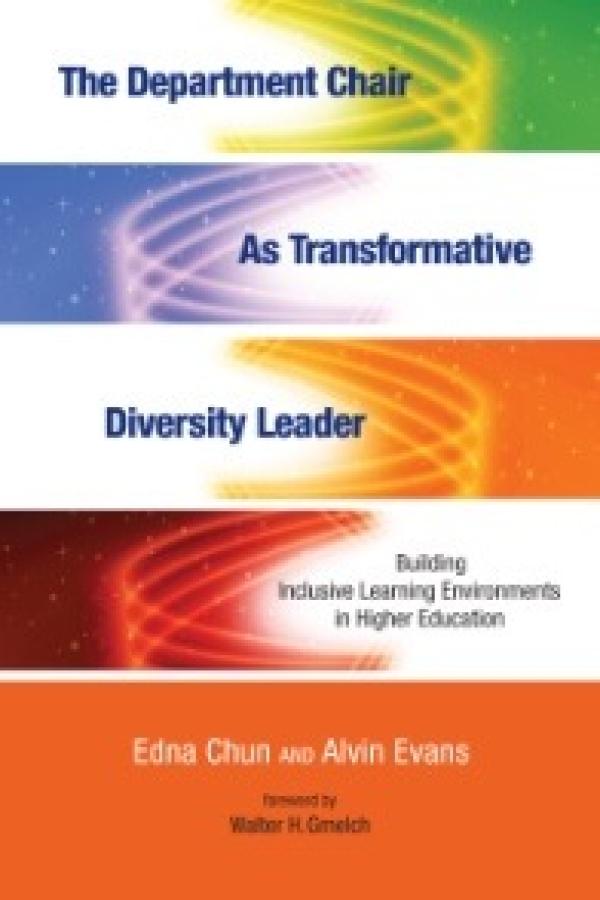
Edna Chun and Alvin Evans’ work on the department chair and diversity fills a gap in the literature on academic leadership. They argue that the academic chair is the pivot for diversity in higher education, particularly as increasing numbers of minoritized students enter the academy. Student diversity contrasts with the overwhelming white maleness of academic administrators, including 90 percent of chairs. Nevertheless, chairs are poised to enhance both the student experience of diversity and diverse faculty diversity development. The authors used an online survey and interviewed chairs across the nation to assess the current level of progress in diversity, to address barriers to diversity, to understand environmental factors that can promote or impede diversity, and to articulate strategies for developing diversity. They were particularly interested in talking with minoritized chairs and in the impact of diversity on student learning. By diversity, they mean race and ethnicity as well as gender and sexual orientation. Chun and Evans recognize that department chairs face many limitations in doing diversity work. Changing upper administrations, maintaining harmony in departments, and other issues take up much chair attention. The work begins with an overview of inequality in America, arguing that the role of higher education is to address this social landscape. They examine the challenges in higher education itself, from the impact of MOOCs to globalization and how department and institutional politics can block chairs’ diversity efforts. Serving students is key: Since minoritized students are at-risk for non-completion, campus climate, including diverse faculty and curriculum, can make a difference in those students’ lives. They also argue, in chapter 6, that interactional diversity is an essential dimension among high-impact college experiences for all student growth. Chairs, who occupy a double role as administrator and faculty, span boundaries and are potential bridge-builders. As both buffers and connections between faculty and administration, skilled chairs have the capacity to reflect on and transform these boundaries to mobilize the various stakeholders towards action. Chairs report to deans (analyzed in chapter 4), and trust in that that relationship is crucial for developing diversity, though the “revolving door” of administration in some institutions poses problems. The discussion of issues that minoritized chairs face and the voices of these persons is an important contribution of this book. These chairs are always proving their competence and may be taken less seriously than their white counterparts. A minority chair may be the only departmental voice for diversity. In terms of sexual orientation, some chairs are limited by institutions’ unwillingness to appoint or policies against appointment of LGBTQI chairs. Like minority faculty, minority chairs face lower student evaluations (see chapter 5), may be isolated and vulnerable, and are under great stress. Another key contribution is strategies, offered by chairs and the authors. Each chapter ends with strategies a chair may implement to address diversity. The final chapters offer suggestions for developing diversity plans, including helpful examples, and additional strategies for overcoming limitations. The description of higher education today, the voices of the chairs, and the multiple strategies offered create a rich study, insightful and practical, for aiding chairs to become leaders for a diverse academy in a global context.

This book contains fourteen essays written by deans of teacher education programs in Canada who are leading change initiatives in the midst of turbulent times in North-American post-secondary education. The book examines reforms in programs designed to prepare effective teachers of the future and address the challenges that deans face in leading these initiatives. A number of the essays emphasize the need for attention to diversity in teacher preparation programs. Although one essay describes diversity in language acquisition programs (25-30), more frequently authors emphasize the need to add Indigenous perspectives to curricula. One chapter examines a program designed to increase the numbers of Indigenous teachers and the awareness of Indigenous culture among non-Native students in teacher training programs, but also raises more fundamental questions about the ways that hegemonic discourses about ethnicity and gender are reproduced in education systems at large (7-12). Another chapter discusses the way that teacher education reforms need to come to grips with white privilege and racism: “Beyond ‘content’ we ask students to ask ‘what is knowledge, how is it privileged, and who does it benefit and why?’” (75). On a different front, one dean grapples with the need to add instructional technology amidst financial constraints (43-48), though another chapter promotes advances in technology use: “relational technology” for building effective bonds between teachers and learners; “cultural technology” which help students overcome the “ethnocentric monoculturalism” of education in the West; and “assessment technologies” that measure student engagement, learning attitudes, and learning strategies (55-60). Other essays focus on the dean’s role in leading effective change. One chapter describes deans as middle managers who walk a tightrope between university executives on the one hand and faculty on the other, in a context where key external constituents doubt that faculty can be trusted to change on their own initiative (61-66). Lack of good decanal leadership negatively affects faculty productivity and damages organization culture, while rapid turnover at this level is associated with increased faculty cynicism about change (31-32). Several authors note the importance of collaborative, democratic decision-making in building a common vision for reform. Some of the strategies described include restructuring departments and committees to maximize faculty participation in decision-making; appointing a faculty steering committee in order to foster widespread engagement; and maximizing faculty choice and autonomy by choosing to change an area that faculty either identify as needing reform or is widely perceived as non-threatening. One author stresses the need to establish a good case for change and the timing of the change (88), while another emphasizes collaborative scanning of the environment (34), a practice identified elsewhere as a crucial factor in building an agile organizational culture. The dean of a faith-based teacher education program advises deans to nurture the quality of their inner life during seasons of change by practicing mindfulness, humility, stillness and attentiveness, and a reorienting gratitude that focuses on abundance versus scarcity (37-42). According to these deans, greater attention to diversity in curricula, relationship-centered pedagogies, and participative, collaborative faculty-led decision-making are the mainstays of successful innovation in teacher education programs. My own experience in leading a large-scale change initiative in a seminary suggests that these same ingredients can be successfully applied in other educational contexts.